
Hurtigruten vs Havila: Which is Best For Solo Travellers?
So you’re staring at two incredible Norwegian coastal voyages and wondering which one is actually best when you’re travelling alone – especially given they both look so similar…
Well, Hurtigruten vs Havila for solo travellers is exactly what this guide will help you decide!
I spent three weeks travelling in Norway solo this past winter, and spent A LOT of time researching and comparing these two coastal routes!
Because when you’re travelling solo, the details matter: whether the communal spaces feel welcoming, how awkward (or stress-free!) dinner is, whether your cabin feels cosy and safe, and if a solo supplement means you’re paying extra just because you’re alone…
This isn’t about which is better on paper, but which genuinely works best for solo travellers.
I’ll break down everything that affects a solo trip – cabins, food, routes, pricing, excursions, atmosphere, and those tiny extra details you need to know – so you can choose whether Hurtigruten or Havila is best for you!
Disclaimer: Some of the links on this blog are affiliate links. That means if you click on one and make a purchase, I may earn a small commission – at no extra cost to you. I only recommend products, places and services I genuinely love and use on my own solo travels. Thank you for supporting my adventures so I can continue to provide free content on this blog! 💛
Hurtigruten vs Havila for Solo Travellers (Quick Comparison)
Note: I am in no way affiliated with Hurtigruten or Havila. All opinions are my own and are based on my own personal experience of the voyage.
| Feature | Hurtigruten | Havila Voyages |
| Route | The Norway Coastal Express Route (34 ports) | The Norway Coastal Express Route (34 ports) |
| Overall Vibe | Traditional, maritime, classic | Modern, calm, design-led |
| Best For | Travellers who appreciate history and heritage | Travellers who value more modern comfort |
| Cabins | Vary by ship, but some are smaller with older décor and porthole windows | Newer, brighter cabins with larger windows for every Seaview room |
| Pricing / Solo Supplement | Often charge a solo supplement, but sometimes remove it in promos | The solo supplement was removed for me 90 days before sailing |
| Food and Dining | 3 meals a day, Coastal Kitchen experience, you can sometimes choose a solo vs a sharing table | 3 meals a day, menu adapts to the route, I was always able to choose a solo vs a shared table |
| Communal Spaces | Panoramic bar, outdoor decks, walking decks | Spectacular panorama lounge, plenty of outdoor space, quiet lounges |
| Excursions | Similar excursions are offered at all ports | Similar excursions are offered at all ports |
| Northern Lights Alerts | Yes | Yes |
| Northern Lights Guarantee | Yes, on the 12-day round trip between late September and late March | Yes, on the 12-day round trip between the start of October and late March |
| Sustainability | Pioneering for green tech but older ships | Sustainable LNG + battery-powered hybrid ships |
| My Personal Choice | — | ✅ |
What is the Norway Coastal Express?
Before we get into the full comparison of Hurtigruten vs Havila, it helps to understand what these Coastal Express voyages actually are – because it isn’t a traditional cruise.
You’re not sailing between private islands, watching live entertainment from the West End or docking at big tourist ports.
Instead, this route is a working coastal route that’s been running for over a century, connecting some of Norway’s most remote towns, islands and communities.
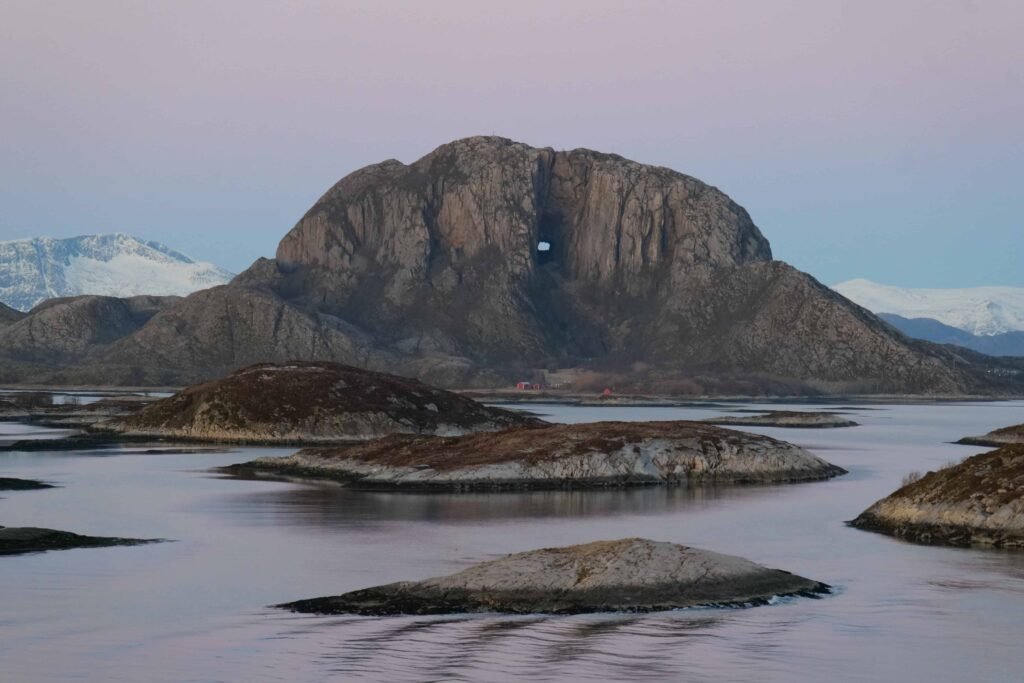
Both Hurtigruten and Havila operate the same Coastal Express route along Norway’s coast, sailing between Bergen and Kirkenes and stopping at 34 ports along the way.
These ships carry locals, cargo, post and tourists – all at the same time!
And that’s such a big part of what made this journey feel so special for me as a solo female traveller. It felt very real and authentic, showing you communities most tourists never see.
Katie’s Top Tip: Where Hurtigruten vs Havila Voyages differ isn’t the route itself, but the ships, onboard culture, dining style, cabins and overall feel. Hurtigruten is the original operator, whereas Havila is the newer alternative, offering a more modern experience. Let’s now get into the comparison!

Hurtigruten vs Havila: Ships & History
Before we compare cabins, food or pricing, it helps to understand why these two voyages feel so different. And it all comes back to their history.
While Hurtigruten and Havila sail the same Norwegian Coastal Express route, they were born in different eras, with very different priorities. And that shows up everywhere onboard!
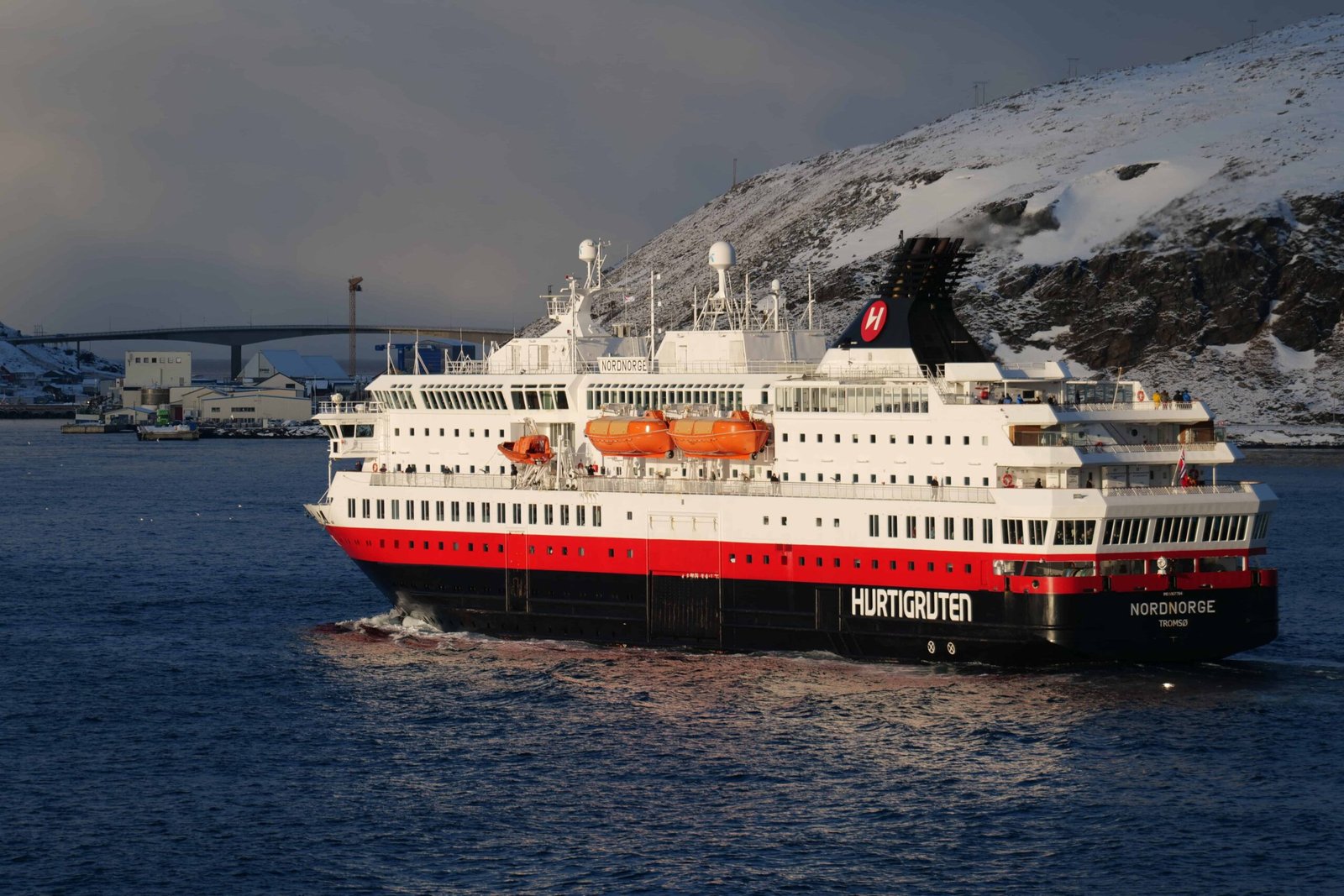
Hurtigruten: The Original Coastal Express
Hurtigruten is the reason this journey exists at all!
Founded in July 1893, it was created to solve the problem of how to connect Norway’s long, rugged coastline when roads barely existed, and winter weather made travel difficult.
For decades, Hurtigruten ships were the only reliable way for people, goods and post to move between Norway’s most remote communities.
And that incredible and historical legacy still shapes the experience on Hurtigruten today.
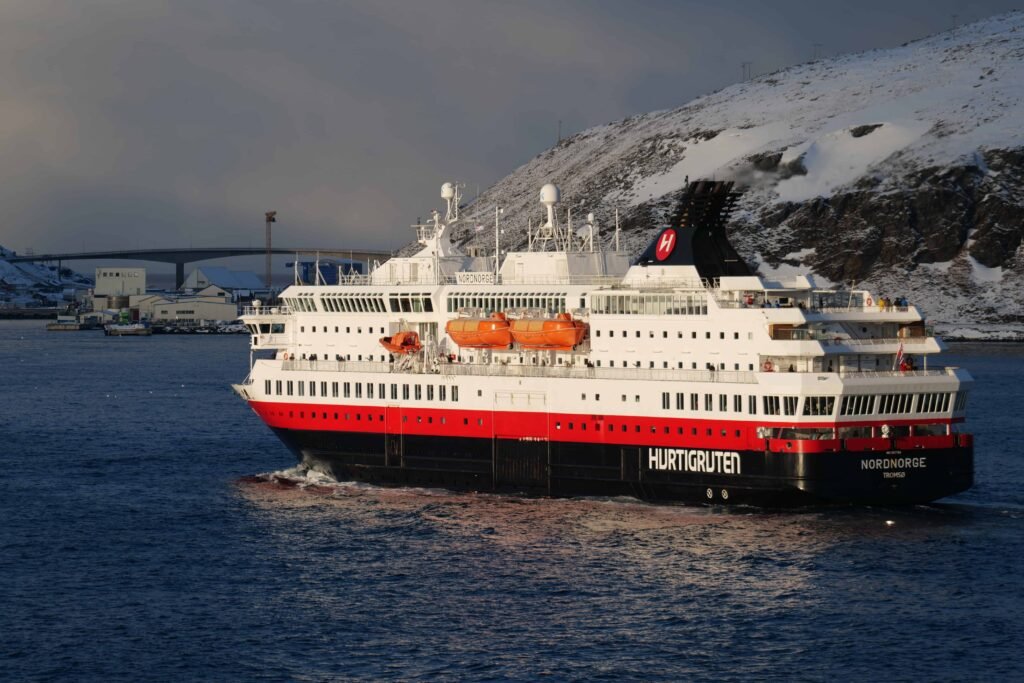
Hurtigruten’s fleet of seven ships feels traditional and functional.
Some vessels have been modernised recently (and more are in progress), but overall the style is classic rather than ultra-modern.
You’ll see locals hopping on and off, cargo being loaded, and crew who’ve spent years (sometimes decades!) working this route.
Katie’s Top Tip: From a solo travel perspective, deciding between Hurtigruten or Havila ships really depends on whether you like that historical, maritime feel. For some, that sense of history is part of the experience, but for others, it can feel a bit dated.
Havila: The Newer, Greener Coastal Express
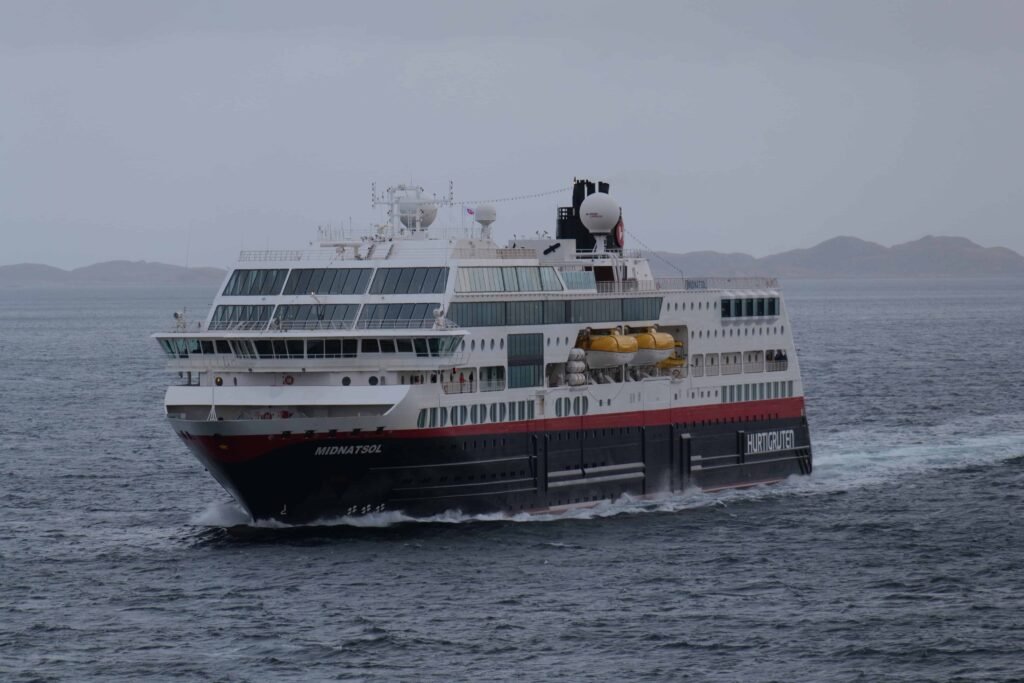
Havila is the new kid on the block (but that’s not a bad thing!)
Launched in December 2021 as a direct competitor for Hurtigruten, Havila’s ships are a lot more modern and are also incredibly sustainable.
The fleet currently consists of four ships: Polaris, Pollux, Castor and Capella. And having sailed on 3 out of the 4, I can tell you that they are all identical in design and offering.
Plus, from a sustainability perspective, all Havila ships are built with hybrid LNG and battery technology, significantly reducing emissions along Norway’s coastline.
Onboard, Havila’s interiors also feel very different to Hurtigruten’s.
Interiors are light, modern, and very Scandinavian, with spaces that feel like they’ve been intentionally designed for ultimate comfort rather than just function.
Havila feels perfect for the modern traveller while still honouring the working nature of the route!
Katie’s Top Tip: If sustainability, modern comfort, and a calmer onboard vibe matter to you, Havila is the perfect choice – especially if this is your first time sailing the Norway Coastal Express route alone!
Why I Chose Havila’s Ships
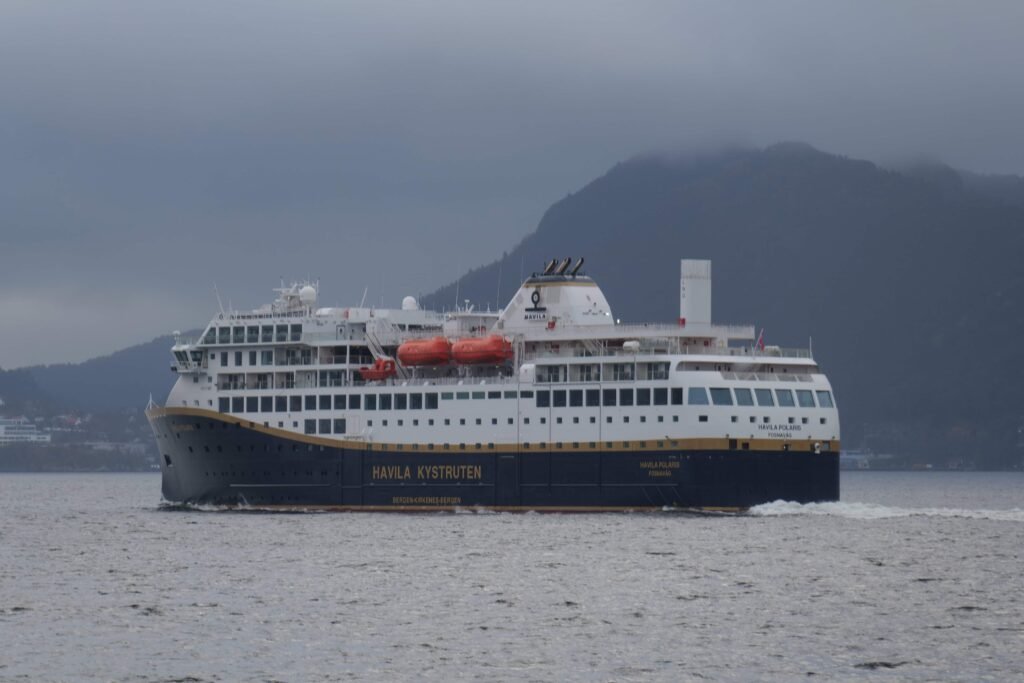
When it came down to my choice between Hurtigruten vs Havila, based on the ships alone, I chose Havila, as it felt aligned with how I like to travel solo.
I loved knowing exactly what to expect from the ship layout, the modern cabins and the quieter, more intentional design of the communal spaces.
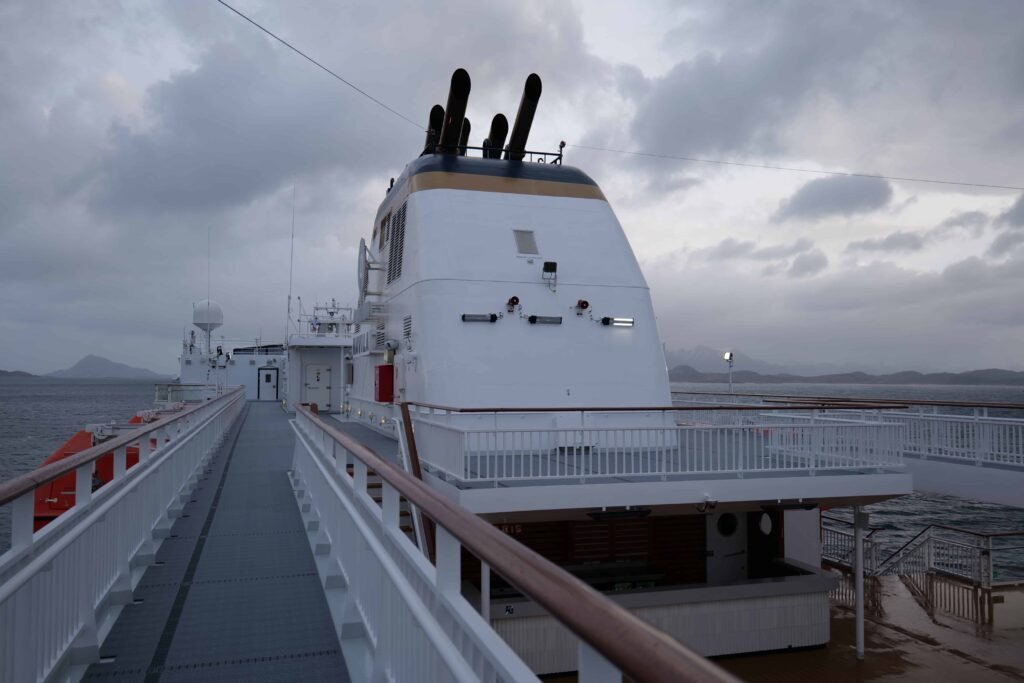
And as someone who spends A LOT of time on deck taking photos or watching the scenery, the huge windows and large outside spaces made a real difference to my experience!
Hurtigruten vs Havila Itinerary & Port Stops
This is the most straightforward part of the Hurtigruten vs Havila debate!
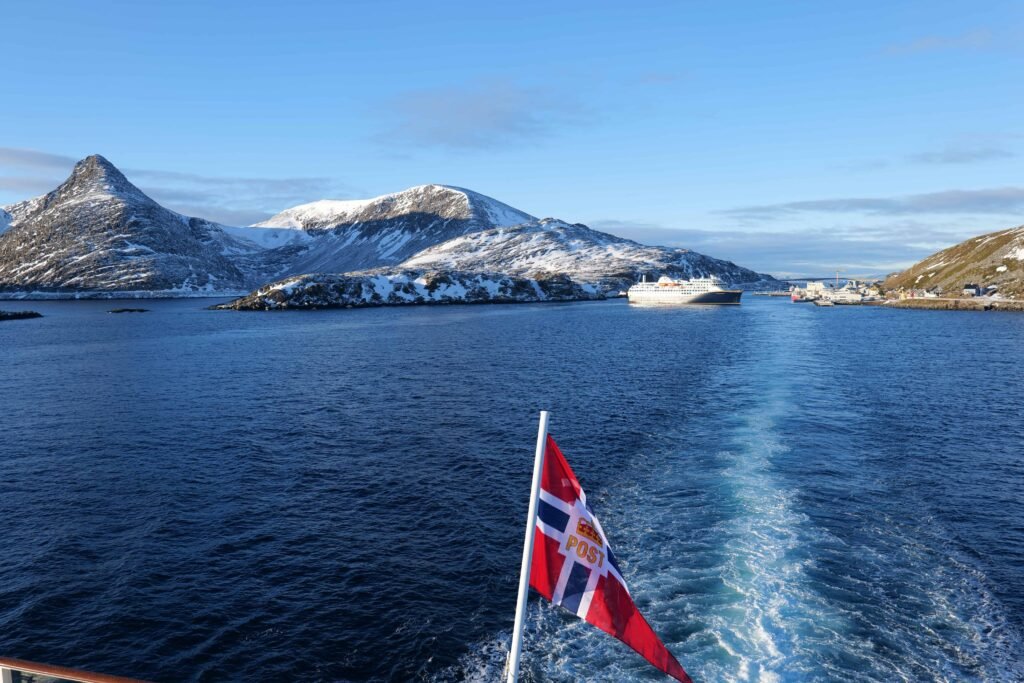
Both Hurtigruten and Havila operate on the exact same Norwegian Coastal Express route, which means the ports are identical, from the stops to the timings and durations.
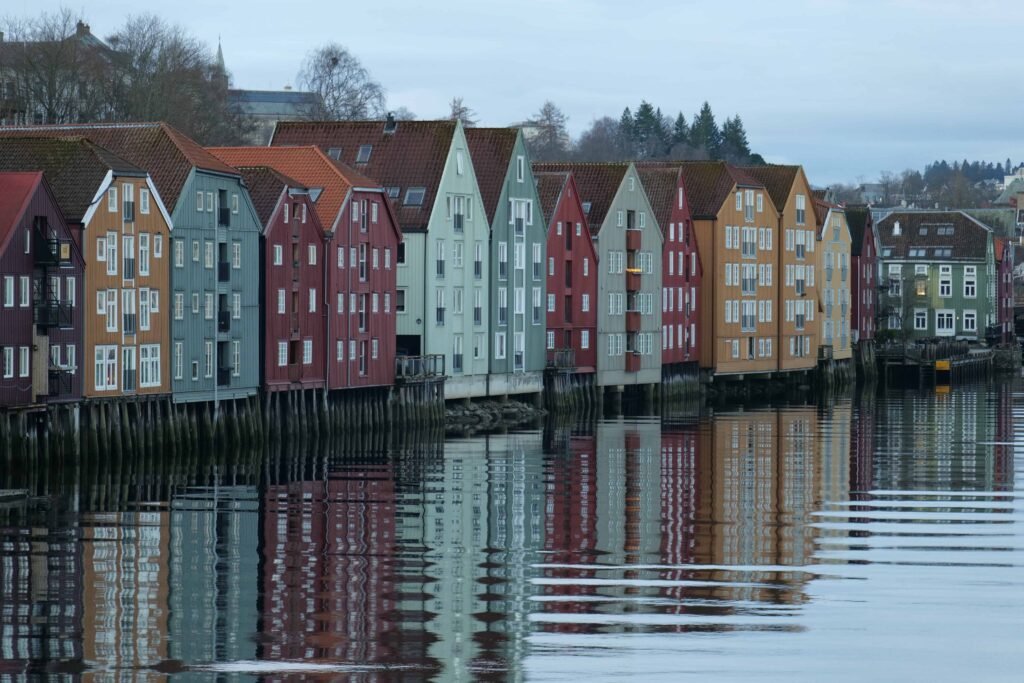
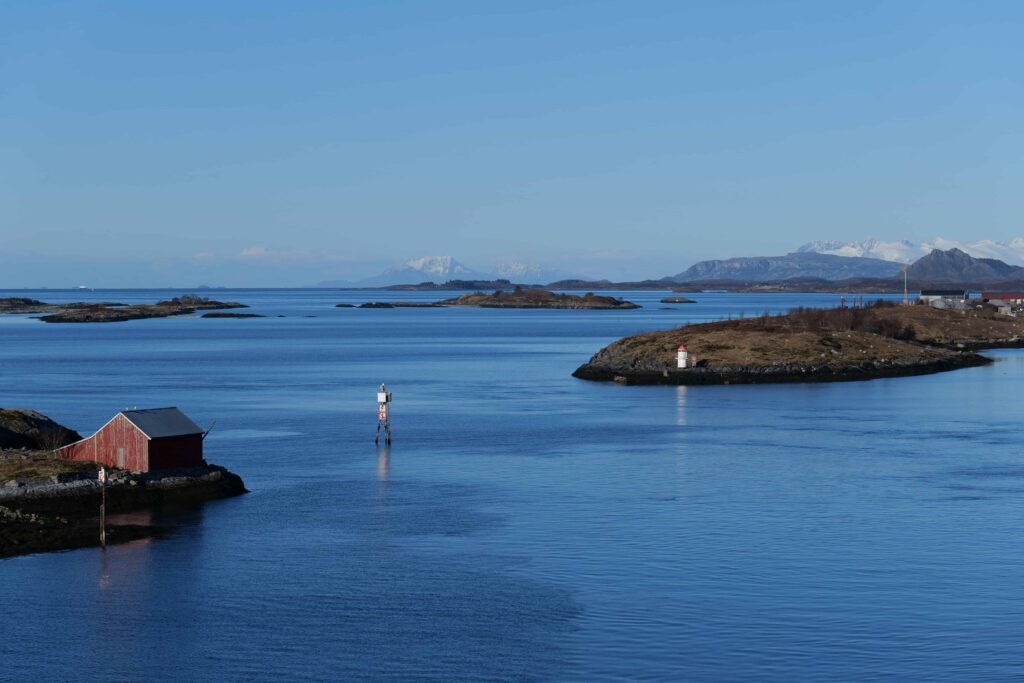
From Bergen all the way to Kirkenes and back, the ships stop at the same picture-perfect towns, cities and villages along the way!
What does differ is how you experience those stops.
For both Hurtigruten and Havila, time in port can be as short as 10 minutes or as long as 10 hours, so knowing what’s realistic to do (and what isn’t) definitely matters.
Rather than repeat myself, I’ve written a detailed, port-by-port breakdown of the full Norway Coastal Express itinerary, including what you can realistically see or do at each stop, what’s worth prioritising, and where you might prefer an excursion!
Hurtigruten vs Havila: Cabins Compared
Your cabin matters a lot when you’re travelling solo. It’s your safe space to reset and relax after a long day of port calls, scenery and maybe even excursions. Let’s break it down:
Hurtigruten Cabins
Hurtigruten offers a wide range of cabin types across its fleet, from basic inside cabins to outside cabins with windows and even suites.
Because the ships vary in age, cabin size, and décor vary quite a bit.
But in general, the cabins on Hurtigruten tend to be smaller, more functional, and more traditional in style.
(Although Hurtigruten are currently upgrading their ships to make their cabins feel more comfortable and modern, in line with Havila.)
In all Hurtigruten cabins, you get a TV, private bathroom and WIFI included.
Katie’s Top Tip: If choosing Hurtigruten, book a “polar outside” or “arctic superior” cabin if your budget allows. And also double-check that you’re booking a proper window and not just a porthole or restricted view. This is a big difference compared to Havila, as all Havila Seaview cabins have a picture window and view, whereas with Hurtigruten, you have to upgrade from interior AND restricted view to get that. But regardless, a window makes a huge difference!

Havila Cabins
Havila’s cabins were one of the biggest reasons I chose to sail with Havila Voyages.
Like Hurtigruten, they offer interior cabins, Seaview cabins and a range of suites.
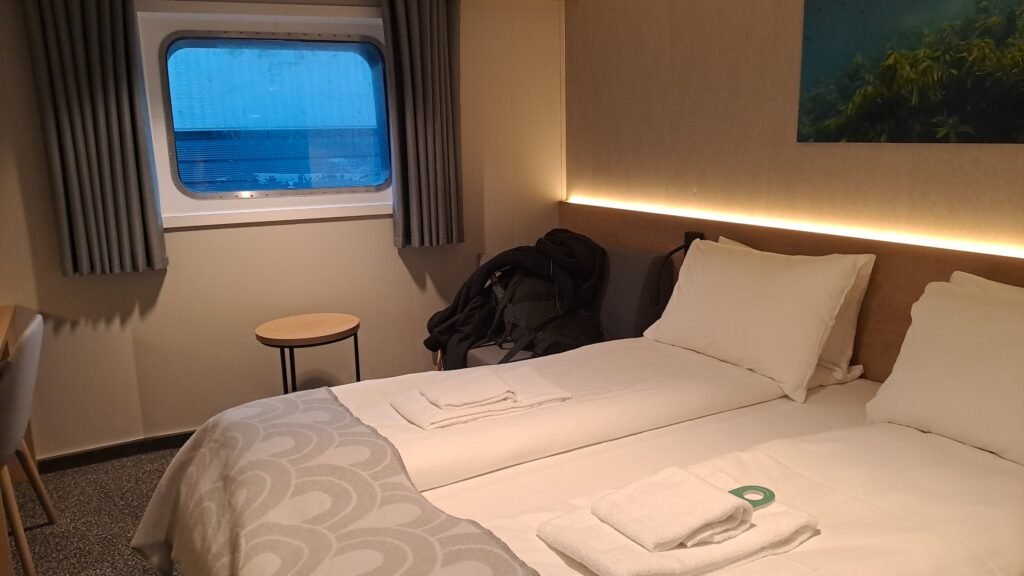
But, unlike Hurtigruten, they feel more spacious, with more intentional storage, bright and comfortable interiors, and a clearer pricing structure for interior vs Seaview cabins.
With Havila Seaview cabins, you know you are getting a large, unobstructed picture window. Whereas, with Hurtigruten, you have to upgrade twice to get that.
Included in all Havila cabins is a TV, free WIFI, a hairdryer, a private bathroom and a sofa.
For Seaview cabins and above, you also get an outside view, a desk with a chair, a fridge, and tea and coffee-making facilities.
Katie’s Top Tip: If you value comfort, light and bright interiors, and a space that feels like a home from home, Havila cabins are a great choice for solo travellers!
Why I Chose Havila’s Cabins
I actually chose Havila largely because of their cabins.
Travelling in Norway solo in winter, I wanted a space to come back to that felt safe, warm, calm, cosy, and somewhere I actually wanted to spend time (not just sleep!)
And Havila provided all that and more!
During my sailing, I found that waking up to the large window and incredible sea views made a huge difference to my experience, as well as the comfortable and thoughtfully designed layout.
If you want to know more about the Havila cabin layouts, categories, and which type is best for solo travellers, I’ve written a full Havila cabin guide.
Hurtigruten vs Havila: Solo Supplements & Pricing
Money is one of the biggest stress points when you’re travelling solo because you don’t have anyone to share costs with. Also, on most cruises, there is a solo supplement – so there’s a lot to consider when comparing Hurtigruten vs Havila on this!
Hurtigruten Pricing
Hurtigruten’s pricing depends a lot on the season, ship, cabin category and demand.
Summer is generally the most expensive season, the shoulder seasons (spring and autumn) are the most affordable, and winter sits in between because of the Northern Lights.
Cabin prices range from the cheapest interior twin cabin to the most luxurious suites (some even with their own balconies!)
And Hurtigruten also uses variable pricing, which means that prices go up with demand.
Solo supplements also apply as standard, but Hurtigruten occasionally removes or reduces them as part of special promotions (especially outside the peak summer months).
These deals aren’t guaranteed and often don’t last, so keep an eye on their offers page, especially around Black Friday.
What is generally included in your price is:
- Accommodation
- WIFI
- All main meals (for longer voyage passengers)
- Port stops (which vary between short 10-minute calls and longer, sightseeing ports)
- Access to all onboard communal spaces, including the hot tub
Excursions, drinks and some premium dining options are all extra.
Katie’s Top Tip: If you’re flexible with dates and cabins, Hurtigruten can sometimes come out cheaper, but this requires patience and monitoring deals.

Havila Pricing
Havila’s pricing felt more transparent to me.
When I was booking, base fares were lower than Hurtigruten to begin with and, importantly, the solo supplement was removed 90 days before sailing.
I didn’t have to chase it, phone anyone or wait for a flash sale. It just happened!
(Although, of course, pricing is always changing, so it is always worth staying up to date with Havila’s offer page and contacting Havila directly if you want clarity as a solo traveller).
Like Hurtigruten, Havila includes:
- Accommodation
- WIFI
- All main meals (for longer voyage passengers)
- Port stops (which vary between short 10-minute calls and longer, sightseeing ports)
- Access to all onboard communal spaces, including the hot tub
Excursions, drinks, and fine dining (with the exception of suite passengers) are all extra.
Seasonal pricing still applies, more expensive in summer, lower in shoulder season, and mid-range during the Northern Lights. And variable pricing is applied to popular sailings.
But overall, costs felt a lot more predictable.
Katie’s Top Tip: If you’re sailing solo, it’s definitely worth waiting until 90 days before to see if the solo supplement is removed. When I booked, it was removed for interior and Seaview cabins, excluding suites.
Why I Chose Havila for Affordability
For me, another big part of my decision between Havila vs Hurtigruten came down to cost clarity, especially around the solo supplement.
Knowing the solo supplement would be removed 90 days before sailing meant I could plan confidently, instead of just hoping a deal would pop up.
And even regardless of that, I still personally found Havila to be cheaper than Hurtigruten for the grade of cabin I wanted (Seaview).
I even phoned up Hurtigruten around Black Friday, and while they were very helpful, they were unable to provide me with a better deal than Havila.
Hurtigruten vs Havila: Food & Dining
Dining often feels like the most awkward and anxiety-inducing part of any solo trip! So let’s break down Hurtigruten vs Havila for food and overall dining experience.
Hurtigruten Food & Dining
Hurtigruten’s dining experience is based around their Coastal Kitchen, which focuses on regional Norwegian ingredients and traditional flavours.
For longer voyage passengers, breakfast, lunch and dinner are usually included in the price.
Breakfast in the main Torget restaurant serves a selection of hot dishes and a cold buffet with fruit, cereal, bread, smoothies, juices, etc.
Lunch in the main Torget restaurant uses local produce to reflect Norway’s coastline. It is served as plated dishes alongside a buffet.
And finally, dinner in the main Torget restaurant is three courses, with meat, fish and vegetarian options. The menu reflects the Norwegian coastline and is served to you.
With seating in Hurtigruten’s main dining room, you can sometimes pick your preference between a solo table vs a communal table. However, this isn’t always possible if it’s busy.
There are also more exclusive restaurants on board that you can pay extra for, including Kysten for a la carte dining and the Brygga onboard bistro.
Finally, there is a café, Multe, serving snacks.
Katie’s Top Tip: If dining solo makes you nervous, aim for an earlier or later meal time rather than in the middle, as it’s usually quieter then.
Havila Food & Dining
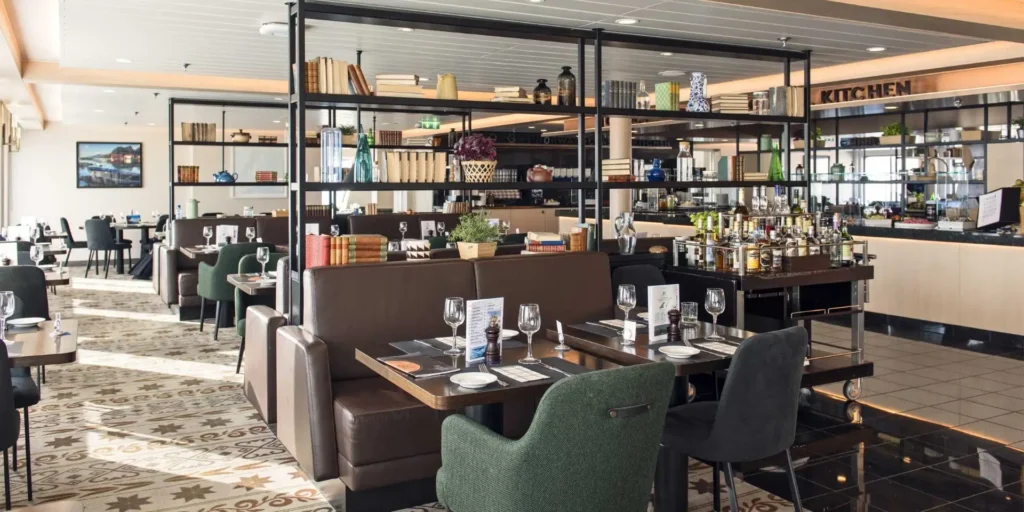
Havila’s dining experience is very similar to Hurtigruten, prioritising local Norwegian ingredients on a menu that changes four times throughout the voyage to reflect the area of Norway you are sailing through.
For longer voyage passengers, breakfast, lunch and dinner are usually included in the price.
Breakfast in the main Havrand restaurant serves a selection of hot plates (like eggs, bacon, pancakes, sausages, etc) and a cold buffet with fruit, cereal, bread, smoothies, juices, etc.
Lunch in the main Havrand restaurant changes four times throughout the voyage (with a couple of options staying the same). And they recommend you choose three small plates plus the surprise dessert.
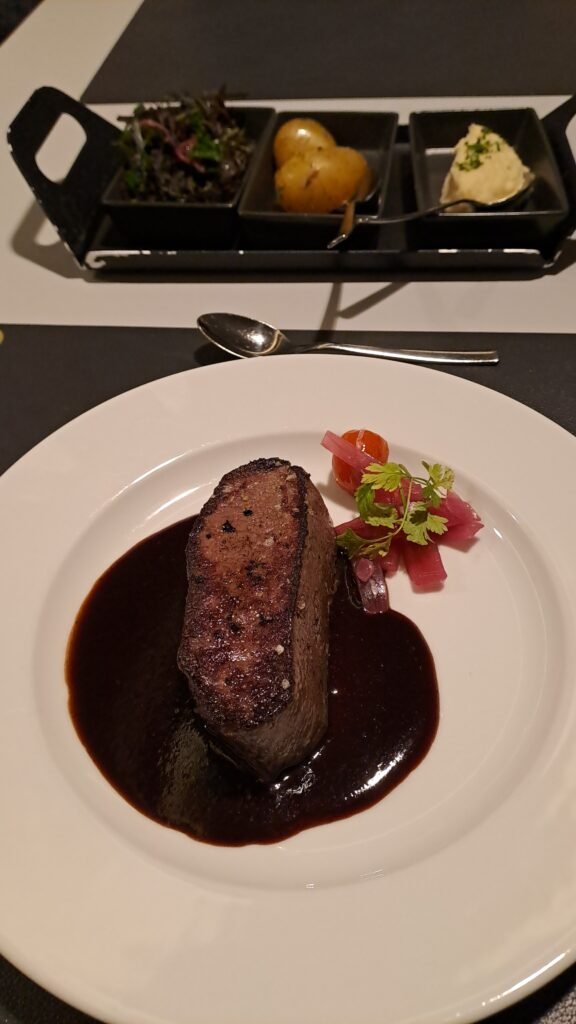
And finally, dinner in the main Havrand restaurant is three courses, with meat, fish and vegetarian options. The menu changes four times throughout the voyage to reflect the changing coastline (with a couple of options staying the same) and is served to you.
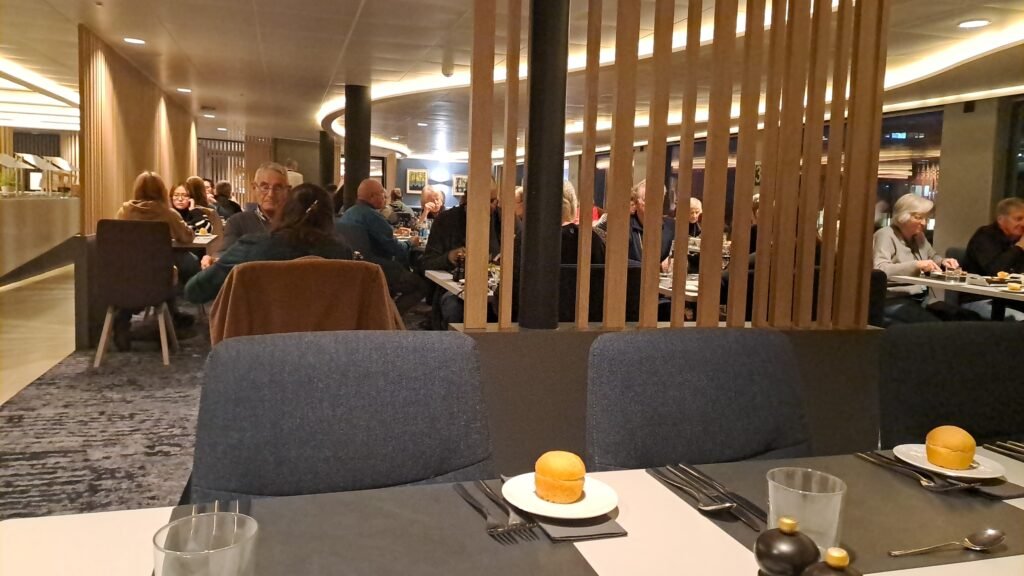
Seating is also great on board Havila for solo travellers.
Breakfast is flexible, and I was always asked whether I preferred a solo or shared table.
And then on your first lunch, you’ll be asked whether you prefer a solo or shared table. I personally chose solo, and that table remained mine for the entire 12-day round trip.
There is also the Hildring Fine Dining restaurant that you can pay extra for.
And a café onboard called Havly, serving snacks.
Katie’s Top Tip: You can add your allergies or any preferences before you board, and staff are incredibly diligent about checking this.
Why I Chose Havila for Food
I chose Havila because dining felt so stress-free, even as a solo traveller.
I was always asked my preferences for a solo vs shared table, so there were never any assumptions, and of course, the food was delicious too!
Havila also do Havila Food Stories throughout the voyage, where you get to try various traditional Norwegian specialities (at no extra cost) and learn a bit about Norway’s food heritage. It’s well worth attending!
Hurtigruten vs Havila: Communal Spaces
If you’re anything like me, you’ll spend a lot of time enjoying the communal spaces on board your ship, from the outdoor decks to the cosy lounges! So they can really define your experience when you’re not in your cabin.
Hurtigruten Communal Spaces
Hurtigruten ships offer multiple lounges, outdoor decks, a briefing room, a gym, a sauna and a shop, but the layout depends a lot on the ship.
Outdoor decks for walking or photos can be found spread across the decks, usually with a smaller walking deck in the middle of the ship and a large observation deck at the top.
There are also several lounges, with a bar and lounge with big windows on the top deck, and smaller, cosier lounges throughout the ship.
Other amenities include a gym with incredible sea views, a lecture hall where you can attend daily briefings, and a sauna to relax in.
The design, like the cabins, is generally very practical and maritime (and maybe a little dated, depending on your tastes), but it feels very social and comfortable.
Plus, a lot of the Hurtigruten ships have been (or are being) renovated.
Katie’s Top Tip: Because Hurtigruten is the original Coastal Express, their ships are often busier and more social, and it’s harder to find a quiet spot. I recommend heading to the top deck early in the morning for the quietest time to relax and enjoy the views.
Havila Communal Spaces
Havila’s communal spaces felt instantly calming to me!
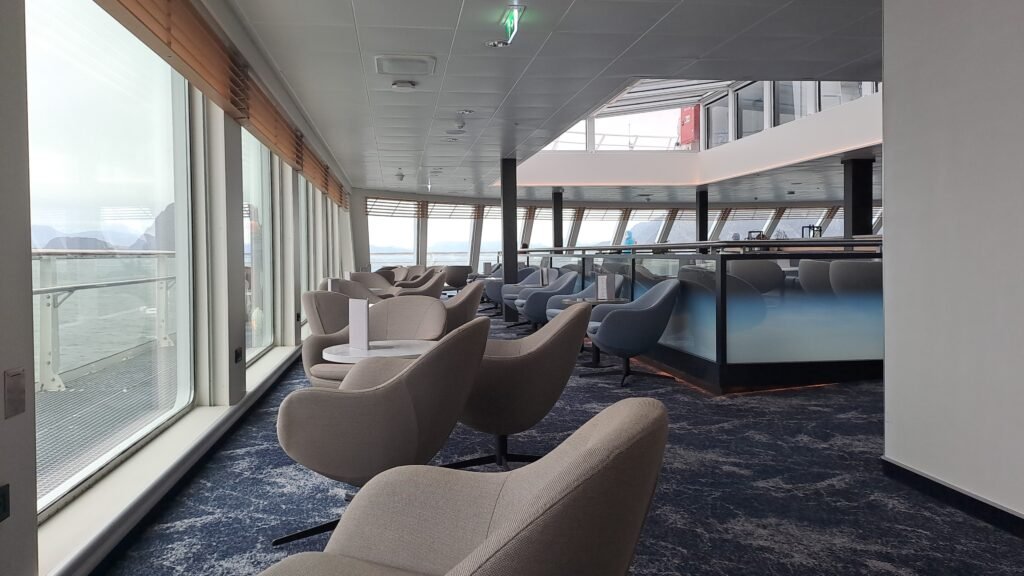
The true standout is the panorama lounge on deck 9, which has huge windows to the front and sides of the ship, with incredible sea views. It also doubles as a bar, but still felt very relaxed, and perfect for quietly watching the coastline drift by.
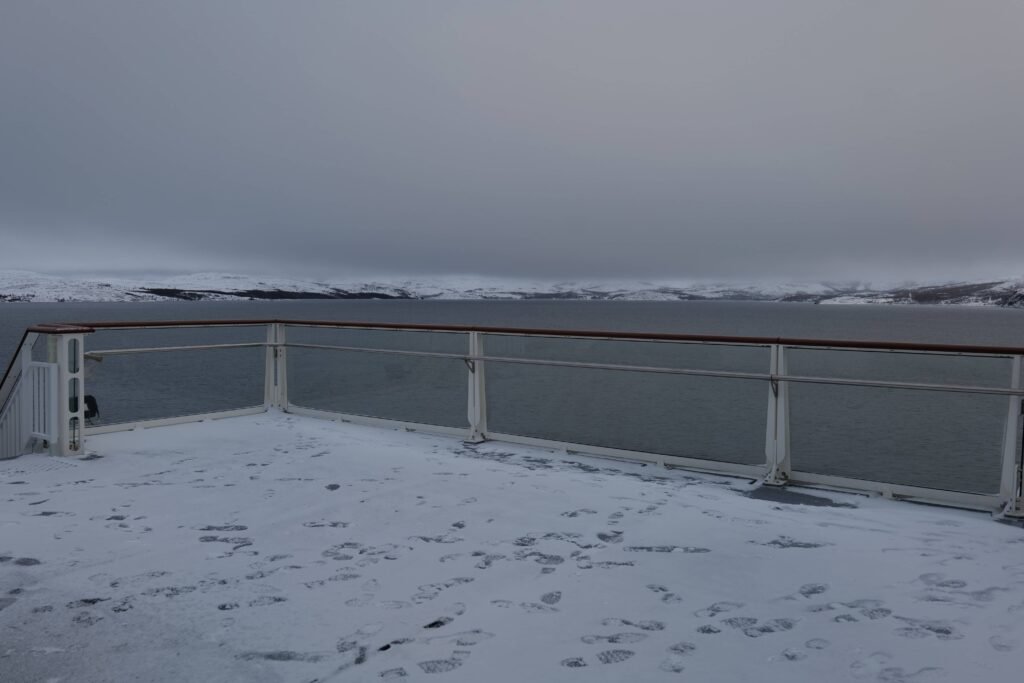
The huge outdoor observation deck on deck 9 is another highlight for enjoying a walk or taking thousands of photos (not kidding!) It’s very spacious and never felt crowded, even during key moments like the Northern Lights or crossing the Arctic Circle.
Design-wise, the interiors feel a lot more modern than Hurtigruten, with bright colours, soft furnishings and plenty of places to sit with an amazing view.
And like Hurtigruten, there’s also a gym with sea views, your pick of a few cosy lounges, a meeting room to attend daily briefings, a well-stocked shop, a sauna and hot tubs.
Why I Chose Havila for the Communal Spaces
For me, a big part of my decision between Hurtigruten vs Havila came down to how the ship would make me feel day-to-day, especially as a self-confessed introvert.
Overall, Havila’s modern design made it easier for me to relax, enjoy my photography, and just enjoy the spectacular coastal views quietly from my cosy spot in the panorama lounge!
Hurtigruten vs Havila: Excursions
When you’re travelling solo, excursions can be very hit or miss.
On one hand, they’re an easy, safe way to make incredible memories without logistics stress. But on the other hand, they can be expensive, crowded, or just not worth it.
The good news, though, is that when it comes to Hurtigruten vs Havila excursions, they are equal. Both partner with the same local operators and offer the same experiences.
Hurtigruten Excursions
Hurtigruten offers a wide range of optional excursions along the Norwegian coast, including husky sledding, snowmobiling, Sami cultural experiences, city walking tours and boat trips.
All Hurtigruten excursions are well-organised and professionally run by local operators.
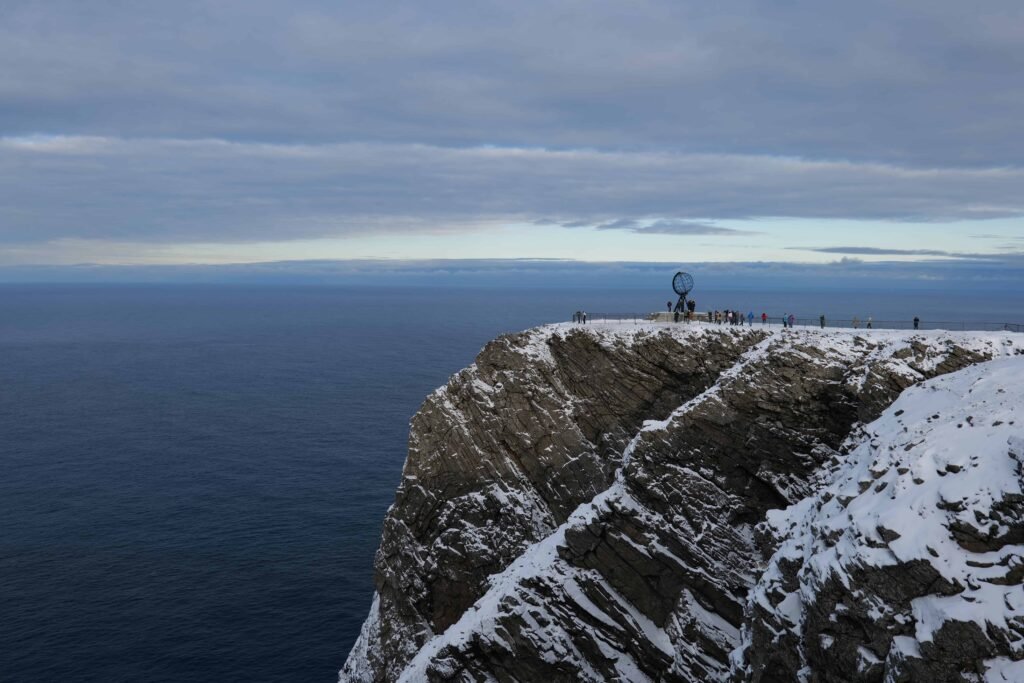
Group sizes vary depending on the activity, ranging from small-group experiences to big bus tours to iconic attractions like North Cape.
Safety briefings are also clear, guides are experienced, and transport logistics are handled from ship to activity and back again (so you don’t have to worry about missing your ship!)
Katie’s Top Tip: With both Havila and Hurtigruten, you can’t (and don’t need to!) book a Northern Lights excursion to see the aurora. Both ships have a Northern Lights alert system onboard, meaning announcements are made to your cabin if they appear over the ship.

Havila Excursions
Havila Voyages offers excursions that are almost identical to Hurtigruten’s. So that means you’re getting the same types of activities and even the same local providers.
As a result, when comparing Hurtigruten vs Havila, excursions are not a deciding factor.
Havila’s excursions cover the same highlights of Norway’s coast, group sizes range from small-group to larger bus excursions, and the guides are all professional and local.
Plus, Havila’s excursion operators are liable to get you back to the ship on time, so you won’t risk missing departure (like you might if you booked a 3rd party tour).
On one of my excursions to the Saltstraumen tidal current, we were a bit late for departure due to roadworks. But our driver was in contact with the bridge, and they waited for us!
Also, like Hurtigruten, Havila has a Northern Lights alert system onboard. So there’s no need to pay extra to see the Northern Lights.
Katie’s Top Tip: Don’t feel like you’re missing out if you skip excursions. A lot of the ports, like Trondheim, Ålesund and Brønnøysund, are amazing to explore alone – in fact, I preferred it! I would recommend using your budget for activities you can’t easily do alone (like husky sledding) and then saving money with a self-guided walk in other ports.

Havila Excursions That Were Actually Worth It
I was selective about which Havila excursions I booked, skipping anything I could easily and safely do independently during port stops.
Instead, I prioritised excursions that gave me access to places or experiences I wouldn’t have ever been able to replicate solo, especially in winter conditions.
I’ve broken all of this down (including which excursions are worth your money and which ones I’d personally skip) in my full guide to Havila excursions!
Hurtigruten vs Havila: Culture & Entertainment
The onboard culture and vibe can really change your experience as a solo traveller with Havila or Hurtigruten. And it’s also good to understand the level of entertainment provided on these ships, so you can feel prepared.
Hurtigruten’s Vibe & Entertainment
Hurtigruten’s onboard culture is incredibly relaxed and informal, with no dress codes on the ship (although people do like to dress a little smarter for the Kysten a la carte restaurant).
The ships attract a whole range of ages, locals and tourists, and people travelling as groups, couples or solo, so you won’t feel out of place as a solo female traveller.
And in terms of entertainment, this is definitely not like a traditional cruise ship, with no flashy concerts or West End-style theatre shows.
Instead, the lecture hall hosts a daily briefing to share more about Norway and also talk through the next day’s sailing.
And there is also a traditional Arctic Circle Crossing ceremony on day 4.
Katie’s Top Tip: I have heard from fellow passengers that because of Hurtigruten’s history and traditional décor, it attracts more locals and older passengers. I can’t say for sure if this is correct on every ship, but I didn’t find that at all on Havila.
Havila’s Vibe & Entertainment
Havila’s culture is also very relaxed and informal, with no dress codes even for dinner (although, again, I did notice passengers dress a little smarter for the Hildring Fine Dining).
I went down to dinner each evening in leggings and a fleece and never felt out of place!
The ship also attracts a wide variety of ages, locals and tourists (although I will say there were not as many locals as I was expecting), travelling in groups, couples or solo.
I never felt out of place as a solo female traveller in my 20s.
There were lots of other people on board solo, and I met two lovely ladies who were also solo female travelling this route, as well as some lovely couples and families too.
Everyone was really friendly and sociable, but not in an overwhelming way.
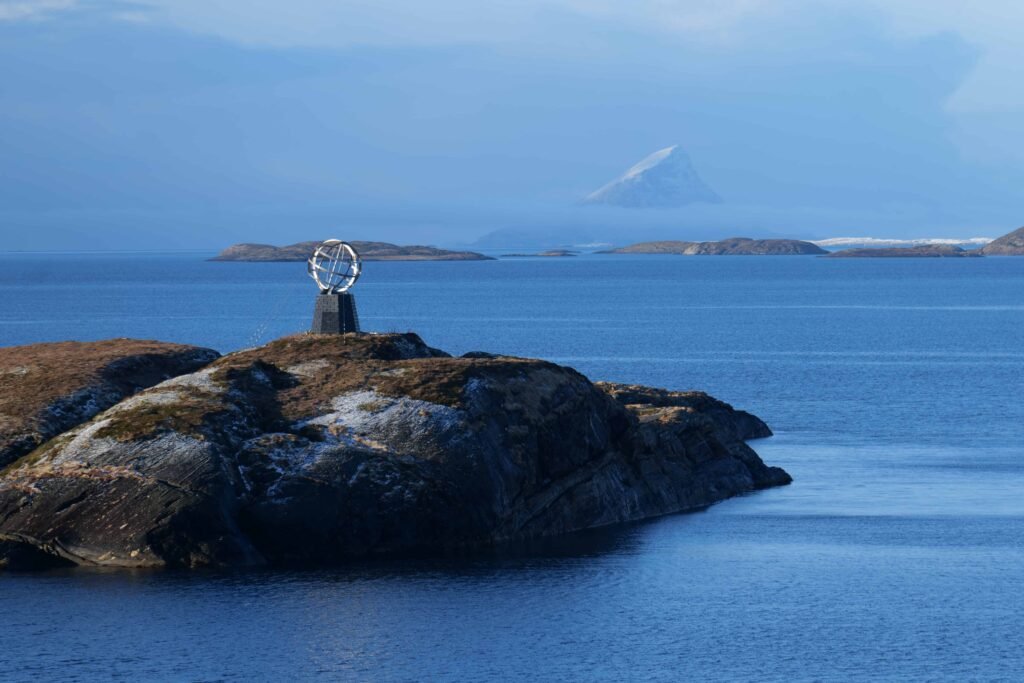
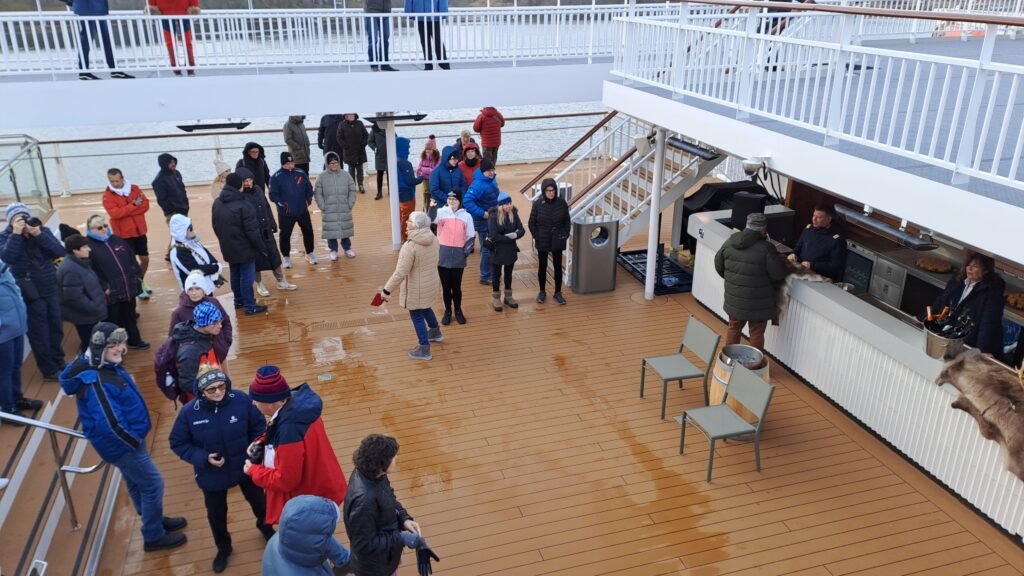
In terms of entertainment, Havila also hosts a daily briefing and an Arctic Circle Crossing ceremony on day 4 (just after leaving the port of Ørnes), where everyone gathers on deck to celebrate the crossing and take on the ice ladle (if you dare!)
Also on board, I noticed a couple of quizzes held in the lounge.
And there were two “trolldrink” ceremonies (hot apple juice or hot apple cider in a souvenir mug) out on deck, where we all gathered together to sail through the picturesque Raftsund.
Katie’s Top Tip: Both Havila and Hurtigruten ships are small, but I loved how spread out and light Havila’s interior spaces were, especially. It felt like nowhere was ever overwhelmingly crowded!
Why Havila Felt Right for Me
In the end, when deciding between Hurtigruten vs Havila voyages, I felt that Havila’s spacious layout gave me the most freedom to choose when and how I wanted to socialise.
I could be alone on deck with my camera or relaxing in the lounge, but equally I could enjoy easy conversation over dinner or join in one of the fun onboard events!
I also didn’t miss the typical cruise ship entertainment, either.
For me, the voyage was all about the scenery anyway. And I loved that the events on board, like trolldrinks or the Arctic Circle Crossing, felt very authentic and Norwegian!
I never felt out of place sailing with Havila solo, even as a woman in my 20s.

Hurtigruten vs Havila: Sustainability
If sustainability really matters to you when booking travel, this is one area where Hurtigruten vs Havila shows a clear difference.
Hurtigruten’s Sustainability Approach
Hurtigruten has been operating along the Norwegian coast for over a century, and they’ve played a major role in pushing sustainability in expedition cruising.
They were early adopters of hybrid technology and are making ongoing efforts to reduce emissions across their fleet, including developing a zero-emission ship by 2030.
They are also committed to reducing their environmental impact as a company, reducing waste and supporting local communities.
However, many Hurtigruten ships are older, and until they are all modernised, they don’t have the same capabilities as newer vessels.
This is something Hurtigruten is working hard to change, though!
Katie’s Top Tip: If you want to do your bit, you can choose to reduce your room cleaning service during your voyage, to save water and energy.

Havila’s Sustainability Approach
Havila ships are brand new and designed specifically with sustainability in mind.
Their fleet of four all run on LNG and battery power.
This is especially important when sailing through the fjords, as the voyage can be almost silent and emission-free, where nature is most fragile.
Also, like Hurtigruten, Havila plans to be emission-free across its entire fleet by 2030, thanks to battery and biogas technology.
Onboard, Havila’s small plates dining initiative aims to reduce food waste, and they are also focused on reducing plastic use and supporting local communities.
Katie’s Top Tip: Havila offers a room cleaning service every other day to save water and energy.
Why I Chose Havila For Sustainability
I personally chose Havila because I loved knowing I was travelling through the fragile Arctic and fjord landscapes in a way that’s sustainable and low-emission.
Currently, the Havila fleet is one of the most environmentally advanced fleets of ships in Norway, thanks to its biogas and battery technology.
Hurtigruten vs Havila: Stability & Seasickness
If you’re prone to seasickness or anxious about rough seas, this section is for you!
Hurtigruten Stability
Hurtigruten’s fleet of ships is designed for year-round sailing along the coast of Norway and handles rough conditions really well, through the harshest winters.
The fleet uses advanced stability systems that are extremely effective at ensuring sailing is safe and feels comfortable throughout the voyage – in all conditions.
Katie’s Top Tip: If you worry about seasickness, I recommend booking a midship cabin on one of the lower decks for the most stability. This is the same for Havila.
Havila Stability
Havila’s newer ships felt extremely stable to me, even though I was sailing in sometimes rough weather conditions.
The combination of the fleet’s modern design, advanced stabilisation technology and quieter propulsion makes a noticeable difference to your experience on board.
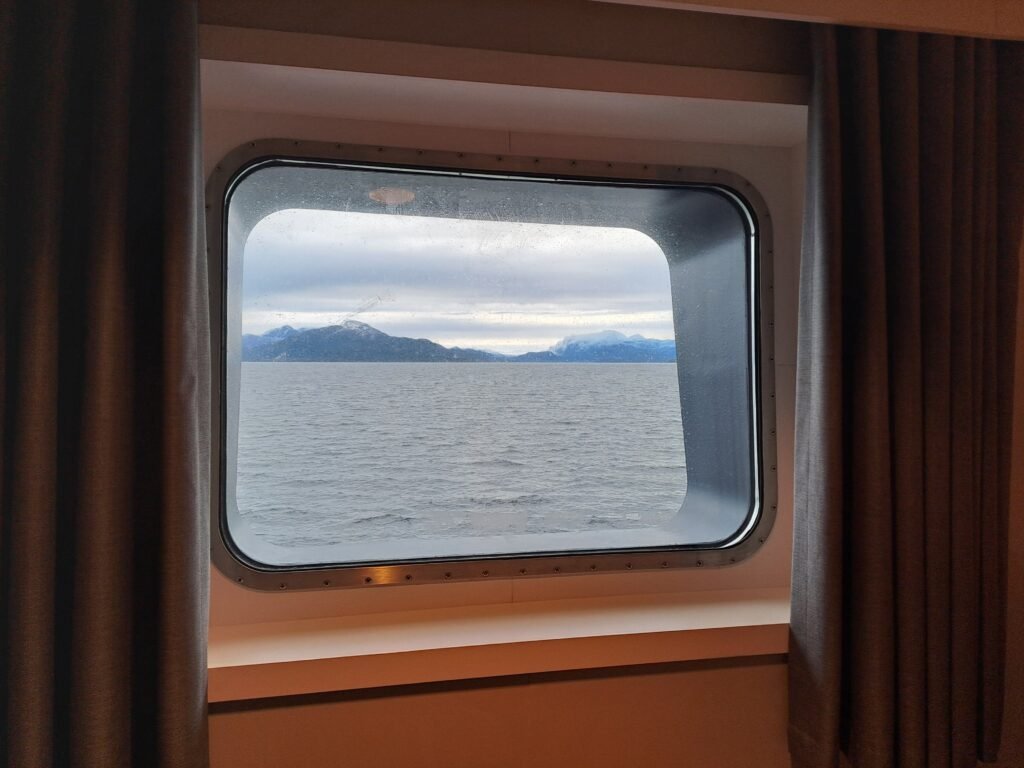
Katie’s Top Tip: With both Havila and Hurtigruten, you should be aware of the times of open sea. These are times when you will be sailing along parts of the coast that are exposed, and there is noticeably more movement. If you are prone to seasickness, consider taking a seasickness tablet a few hours before these times, which you will find advertised in reception and on your cabin TV.
Winter vs Summer
Choosing when to sail is just as important as deciding between Hurtigruten vs Havila, as summer and winter on the Norway Coastal Express feel like two completely different trips!
Summer has long daylight hours, the Midnight Sun further north, and lush green coastal scenery. The ship and ports are busier, excursions sell out faster, and there’s a more social, lively atmosphere onboard.
Winter, on the other hand, is quieter and more relaxed. Daylight hours are short (with Polar Night in the north), ever-changing weather can impact schedules or excursions, and flexibility is key. But you’ll also share the experience with fewer tourists, have lower prices, see snow-covered landscapes, and get the chance to see the Northern Lights!
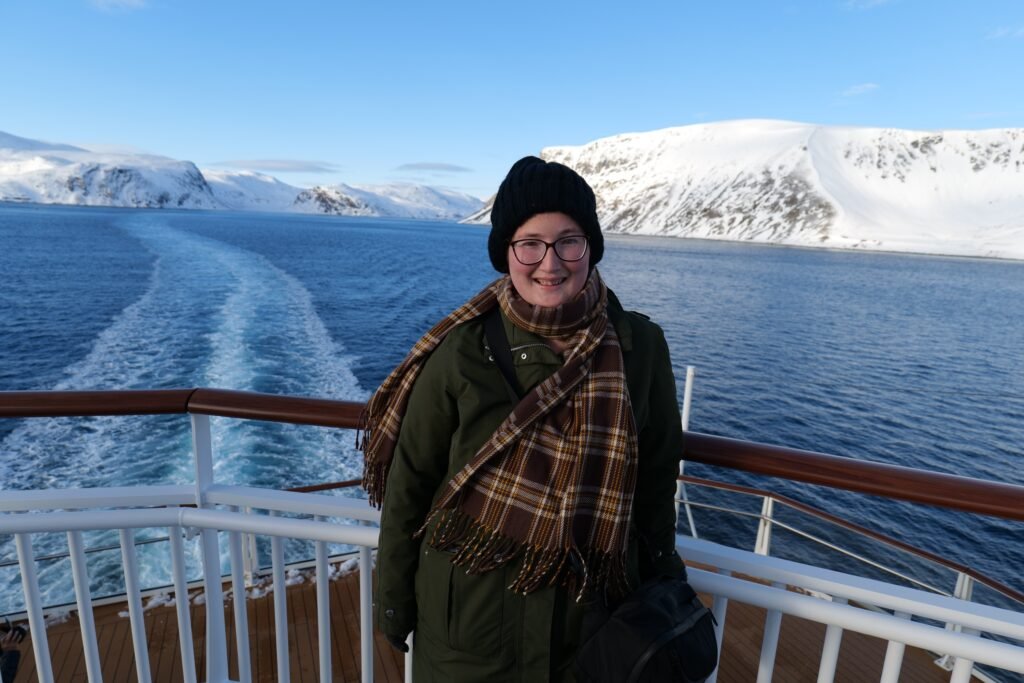
I personally travelled with Havila in winter, and while it was definitely more wild and challenging, I loved it!
The slower pace, quieter ship and truly spectacular snowy scenery were a once-in-a-lifetime experience. Not to mention my first time seeing the Northern Lights on deck!
Katie’s Top Tip: Winter is definitely not the easiest season, with limited daylight, icy ports and weather impacts on excursions or stops, but it is incredibly rewarding! I’ve broken down all the winter logistics, challenges and tips you need to know in my guide to the Norway Coastal Express in winter!
A Solo Day in the Life On Board Havila
One of the biggest unknowns when comparing Hurtigruten vs Havila is what daily life onboard actually feels like when you’re travelling alone. So here is an overview of my days:
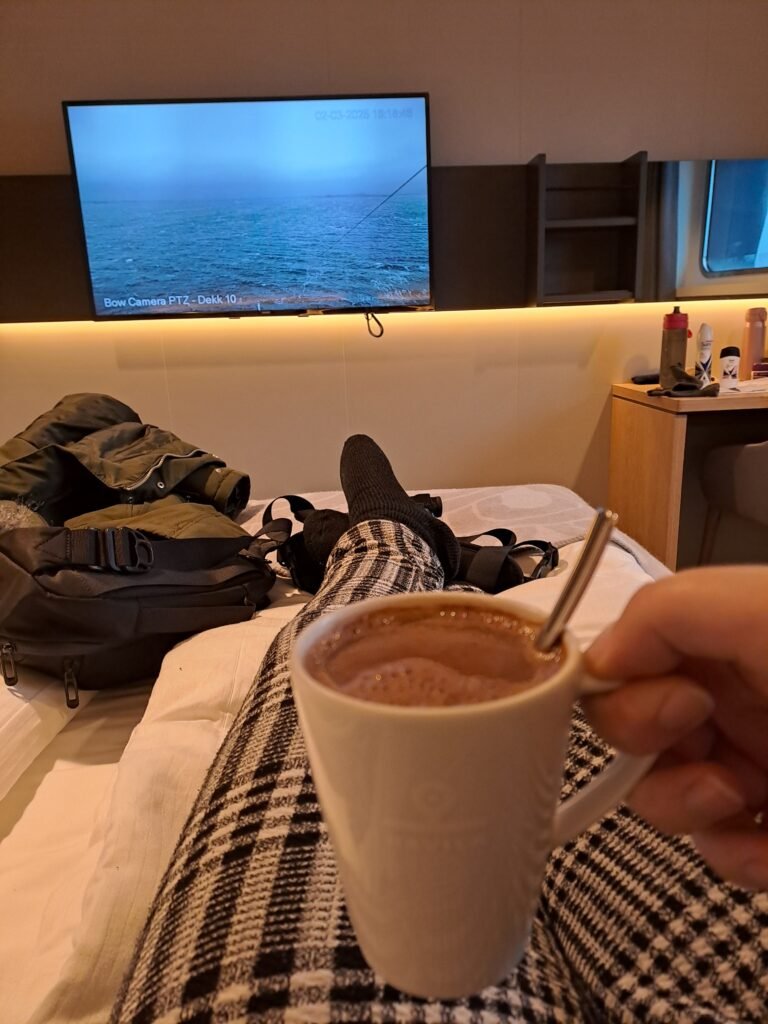
My days started quietly, waking up in my cosy Seaview cabin and immediately checking the window to see where we were sailing past. This was my favourite part!
Breakfast is relaxed and flexible. I normally headed down around 8am for a hot plate of eggs and bacon, some juice and a selection of fresh fruit and yoghurt from the buffet.
After that, I’d head straight to the panorama lounge on deck 9 to claim my “usual” seat near the doors, so I could head outside quickly whenever I wanted to photograph the scenery (which was often!) I spent about 99% of my time on board Havila outside – even in winter!
Lunch runs on an assigned time you choose on day one. I loved knowing that I had a time slot and a set table, and the people next to me were lovely! My favourite dish was the risoni.
Most days also include one main port of call (occasionally two), where you can explore independently or join an excursion.
Also in the afternoon, there’s a daily briefing covering the region, weather, upcoming points of interest, tomorrow’s excursions and Northern Lights conditions. I loved attending these!
Dinner was again at my set time slot and table, and it was a very relaxed (and delicious!) three-course meal.
Finally, my evenings were spent either relaxing in my Seaview cabin or waiting in the lounge to head out on deck to see the Northern Lights above our ship!
Katie’s Top Tip: If you want to hear more about my experiences, I have an ultimate guide to winter on the Coastal Express, a list of excursions worth booking (and some that aren’t), a full cabin review, and a detailed look at the itinerary, with all port stops explained!
Final Thoughts: Why I Picked Havila Voyages
After months of researching Hurtigruten vs Havila (and finally sailing with Havila Voyages in winter for the 12-day round-trip and two port-to-ports), I was so happy with my choice!
I loved the calm, quiet atmosphere on board, the modern but comfortable ship and cabin design, the sustainability focus, and the incredible panorama deck and lounge.
I also never felt awkward dining alone, pressured to socialise, or out of place either as a solo traveller on board OR as a woman cruising in her 20s.
So, if you want a voyage that feels relaxed and independent but also sociable if you want it to be, with thoughtfully designed interiors perfect for modern travellers, Havila is an excellent choice.
But if you’re still unsure? That’s okay!
There’s no wrong choice between Hurtigruten or Havila – both are incredible companies that operate the same spectacular route along Norway’s Coastline – but there is a right one for your personality, comfort level and travel style.
I hope this guide has helped you to trust that instinct!
Hurtigruten vs Havila FAQs
What is the main difference between Hurtigruten and Havila cruises?
Both Hurtigruten and Havila sail the same Norwegian coastal route, stopping at the same ports from Bergen to Kirkenes and back. So the core experience you’ll be getting, from epic scenery to incredible excursions, is the same.
The difference is found in the onboard experience you will receive.
Hurtigruten is the original operator of the Coastal Express and a historic choice, with a fleet of ships that vary in age and interior décor. Its vibe is more classic and functional.
Havila is the newer Hurtigruten alternative, with modern interior design, thoughtful communal spaces and a focus on sustainability. This shows up everywhere, from the cabins and lounges to the overall atmosphere on board!
Do I need to book excursions in advance?
You don’t have to book excursions in advance, but there are definitely benefits to planning ahead (at least for some excursions!)
Both Hurtigruten and Havila offer optional excursions at many ports, and some popular ones can sell out early. So if there’s a must-do activity on your bucket list, book in advance for peace of mind.
Some of the most popular excursions are to North Cape, husky sledding, reindeer sledding, snowmobiling and snowshoeing.
However, you absolutely don’t need to book expensive excursions in every port to have an incredible trip. So many stops like Ålesund, Trondheim, Tromsø and Brønnøysund are perfect (and more affordable!) to explore alone.
What should I pack for the Coastal Express?
Whether you’re choosing Hurtigruten or Havila, packing is the same.
Indoor spaces are warm and comfortable, but decks can be cold and windy, especially in winter.
In winter you’ll want to pack proper thermal layers, an insulated waterproof and windproof jacket, warm socks, gloves you can use your phone or camera with, and sturdy shoes with good grip for icy ports. A small backpack for shore stops and excursions is also essential.
If you want a full, item-by-item list of exactly what I packed, I’ve shared my complete Norway cruise winter packing list here!
Is it easy to meet people onboard?
It honestly depends on whether you want to or not! I found that people were very sociable and happy to chat with me if I wanted connection, but equally there was plenty of quiet time too.
It’s not full on and in-your-face social like some more traditional cruise ships can be!
Because the ships are small, conversation usually happens naturally over shared interests. For example, I was always out on deck with my camera, so conversations with fellow photographers felt really natural.
To connect further with other passengers, you could choose to join a group table for meals.
Is Havila a good Hurtigruten alternative?
Yes! Havila may be running the exact same coastal route, but it definitely isn’t just a carbon copy of Hurtigruten.
For me, as a solo female traveller, I found Havila felt more welcoming, with cosy cabins, spacious and bright lounges and communal areas, and a real emphasis on friendliness (for example, always being greeted by my first name at meals or always being asked whether I wanted a sharing vs solo table at breakfast).
Havila feels like it has been thoughtfully designed for the modern traveller, which I found so reassuring as a solo female traveller!
Read More About Travel in Norway:
- Northbound vs Southbound Norway Coastal Express: Compared
- What to Wear in Norway in Winter? (+ Norway Packing List)
- How to Plan a Trip to Norway in Winter (Step-by-Step Guide)
- Norway vs Iceland in Winter: Ultimate Solo Travel Comparison
- Where to Stay in Bergen (+ Best Areas For Solo Travellers)
- Where to Stay in Tromsø (+ Best Areas For Solo Travellers)
- Hurtigruten vs Havila: Which is Best For Solo Travellers?
- Is Saltstraumen Worth Visiting from Bodø? (+ What to Expect)
- How to Get Around Norway in Winter (Without a Car!)
- How to Visit Trollfjord: Northern Norway’s Most Iconic Fjord
- How to Visit Mostraumen Fjord (Bergen’s Best Day Trip!)
- 7 Things To Do in Hammerfest (Hammerfest Travel Guide)
- Mount Aksla Hike: How to Find the Best Ålesund Viewpoint
- 8 BEST Things To Do in Brønnøysund, Norway: Havila Port Stop
- 21 Most Beautiful Places in Norway You Have To Visit
Grab Your Solo Female Travel in Europe Starter Kit:
Pin Me For Later!



2 Comments