
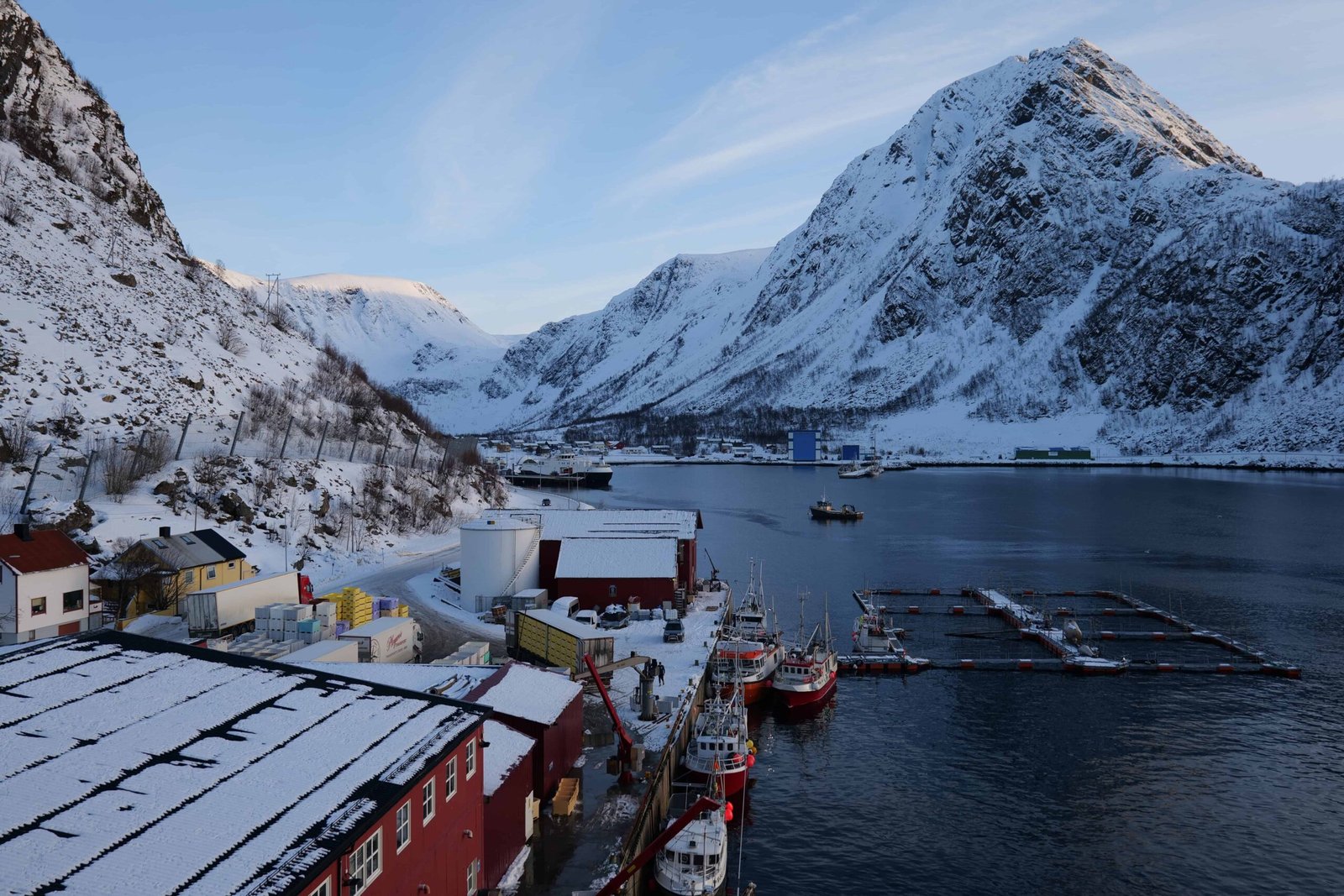
Norway Coastal Express Itinerary: All Port Stops Explained
Planning your Norway Coastal Express itinerary gets so much easier once you understand how all the port stops actually work.
Some are an hour long (and others are up to 10 hours in port), so you can get off to explore or join an excursion.
But others are so quick (just 10–15 minutes) that you barely have time to grab your coat and head out on deck for photos.
If you don’t know the difference, it’s really hard to plan your days on board Havila or Hurtigruten. You don’t know which ports are worth getting off for, which ones you can just enjoy from the ship, or when those unmissable photo opportunities are coming up.
When I sailed the full Coastal Express route solo in winter with Havila, this was the one thing I wish I’d better understood before we set sail.
So, in this guide, I’ll explain every single port of call, in order, with honest impressions and exactly what you can do with your time – from the tiny but beautiful communities you could blink and miss, to the major ports where you can get off and explore!
Disclaimer: Some of the links on this blog are affiliate links. That means if you click on one and make a purchase, I may earn a small commission – at no extra cost to you. I only recommend products, places and services I genuinely love and use on my own solo travels. Thank you for supporting my adventures so I can continue to provide free content on this blog! 💛
The Norway Coastal Express Route: Explained
Day 1 – Sailaway From Bergen
Your Norway Coastal Express itinerary technically starts in the evening, but you’ll have most of the day to enjoy the highlights of beautiful Bergen before you board!
What to do in Bergen?
If you only have half a day in Bergen before the voyage, keep it simple with a walk around colourful Bryggen, before riding the Mount Fløyen funicular for panoramic views over the city.
But if you’ve already seen Bergen’s highlights, I can’t recommend the Mostraumen Fjord Cruise enough!
It runs 10:30am–2:30pm (perfect timing before boarding), and on the way back, you’ll even see your Havila or Hurtigruten ship cruising into port!
I did this on my embarkation day, and it got me so excited for the whole trip, as we cruised through the calm fjords, past dramatic cliffs, thundering waterfalls, and tiny settlements.
Check-in For The Coastal Express
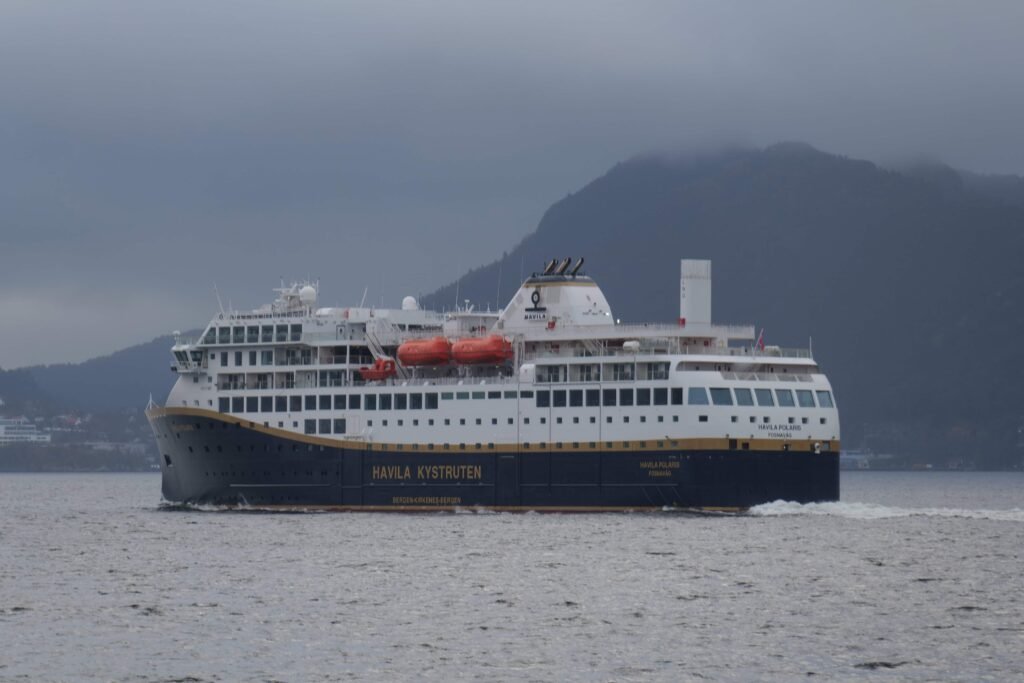
Check-in at the Hurtigruten Terminal (Havila uses the same building) opens around 4pm, where you can drop your luggage, grab your key card, and wait in the waiting room for your cabin to be ready.
The ship sails at 8:30pm, after your welcome dinner (which is open seating for the first night), and please trust me on this: go outside to watch the sailaway!
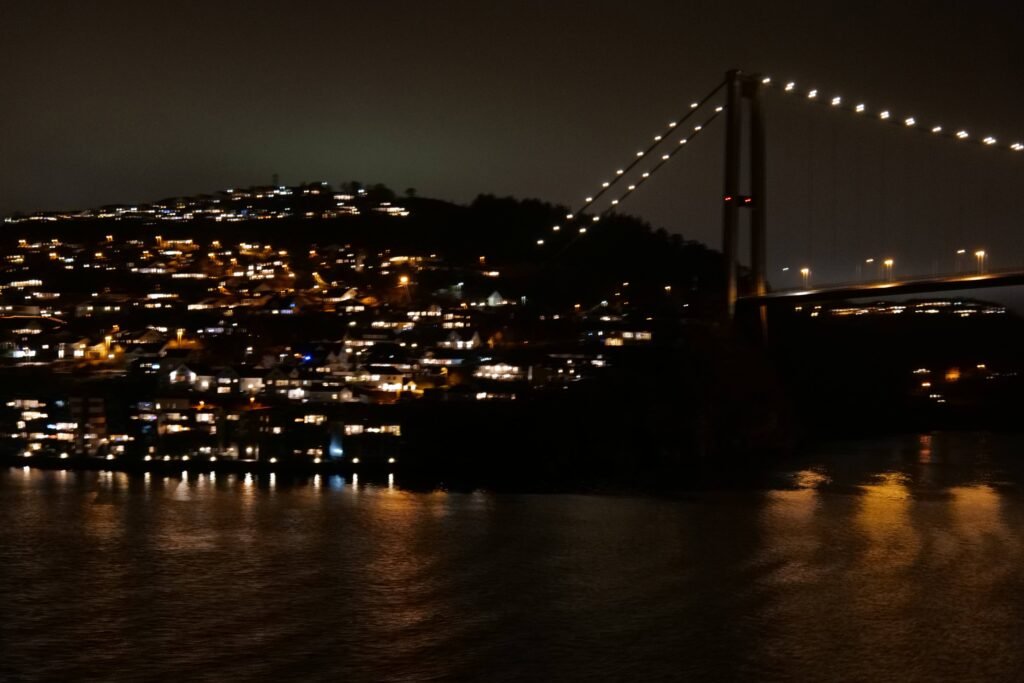
Watching the lights of Bergen slowly fade behind me felt like the real beginning of the voyage, and it was such a special moment.
I was genuinely shocked by how few of my fellow passengers came out on deck to see it.
Katie’s Top Tip: Most of the Coastal Express route is sheltered, but as you leave Bergen, you’ll hit your first stretch of open sea. On my sailing, it wasn’t too bad, but it’s definitely a noticeable difference from the sheltered waters surrounding Bergen. If you think you may be affected, take a seasickness tablet in advance.
Day 2 – Norway’s Beautiful West
Florø: 2:45am–3:00am
Florø, located on the island of Florelandet, is the westernmost town in Norway and a key fishing hub on the route.
Your ship docks here for a brief time in the middle of the night, so you won’t see the port itself on this northbound sailing. However, you will see Florø in daylight, southbound.
Short stops like these also give you a real sense of how vital this postal vessel, ferry service, and cruise ship is for the local communities in Norway!
Måløy: 5:15am–5:30am
Another brief early-morning stop, Måløy is a small fishing town and working port, known for its distinctive Måløy Bridge and surrounding dramatic coastal landscapes.
During these overnight ports of call, you may notice the ship dock or hear a bit of movement outside your cabin, but again, you’ll probably sleep right through it. (I did!)
Torvik: 8:20am–8:30am
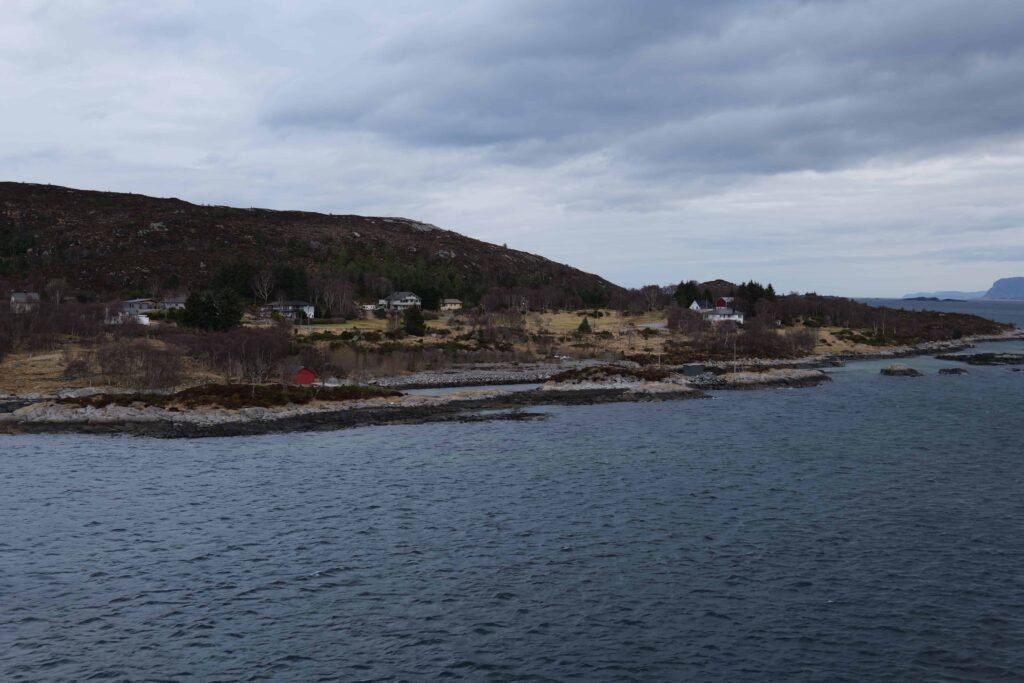
The small village of Torvik is the first port most passengers actually see on day 2 of the Norway Coastal Express itinerary, especially in winter when the sun rises late.
It’s just a quick 10-minute stop, so you won’t be able to get off, but it’s still great to head up to the top deck for some photos and your first look at Norwegian coastal life!
I remember really noticing the stillness at this port stop – only a few tiny houses are dotted around, and you’re surrounded by sea.
Early in the morning, when hardly anyone else is out on deck, it’s such a peaceful moment.
Ålesund: 9:45am–8pm
Your first full day on the Norway Coastal Express has the longest stop of the entire 12-day route: the Art Nouveau town of Ålesund!
In winter and spring, the Coastal Express stays in Ålesund for 10 hours, which is plenty of time to explore the highlights of this charming town.
Whereas, in the summer, you only make a brief stop in Ålesund before sailing to the Geirangerfjord, returning to pick up passengers in Ålesund in the evening.
And in autumn, the Norway Coastal Express ferry heads to Hjørundfjord.
I personally sailed the Norway Coastal Express in winter (February/March), and so stayed in Ålesund for the whole day.
What to do in Ålesund?
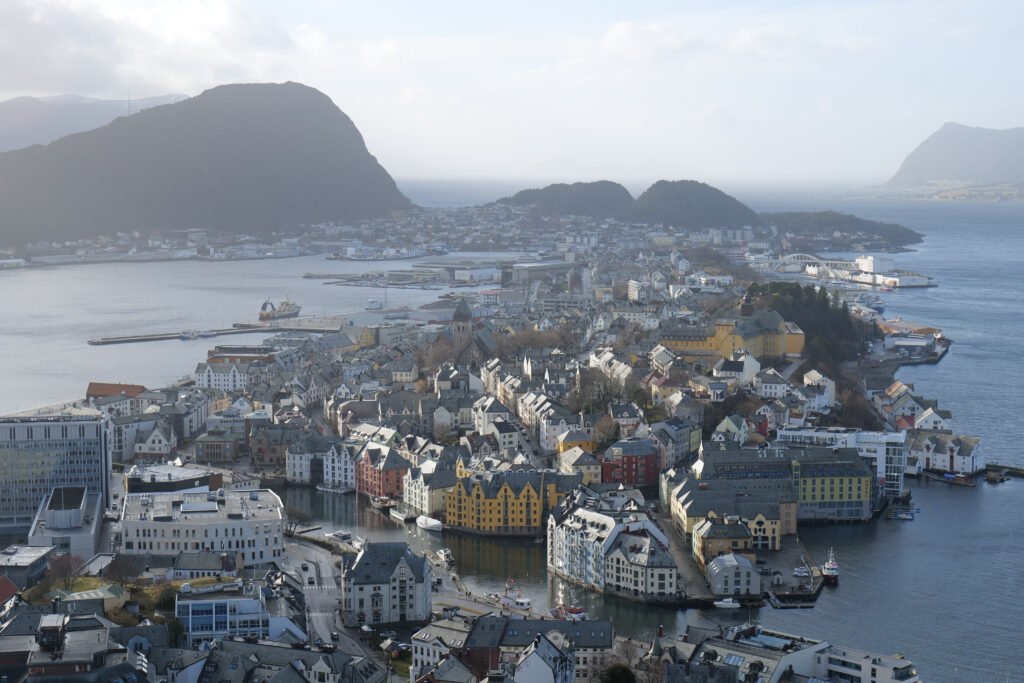
You can easily explore beautiful Ålesund independently, starting with a walk through the Art Nouveau streets and along the colourful waterfront, before heading to Mount Aksla.
The Mount Aksla hike isn’t difficult, but there are a lot of steps (428 to be precise!)
The view from the top is well worth the effort to get there, though, as you’ll look down on the colourful buildings, winding canals, mountains and even your ship, docked in port.
My guide to the best things to do in Ålesund in one day has more ideas for this port call!
Geirangerfjord
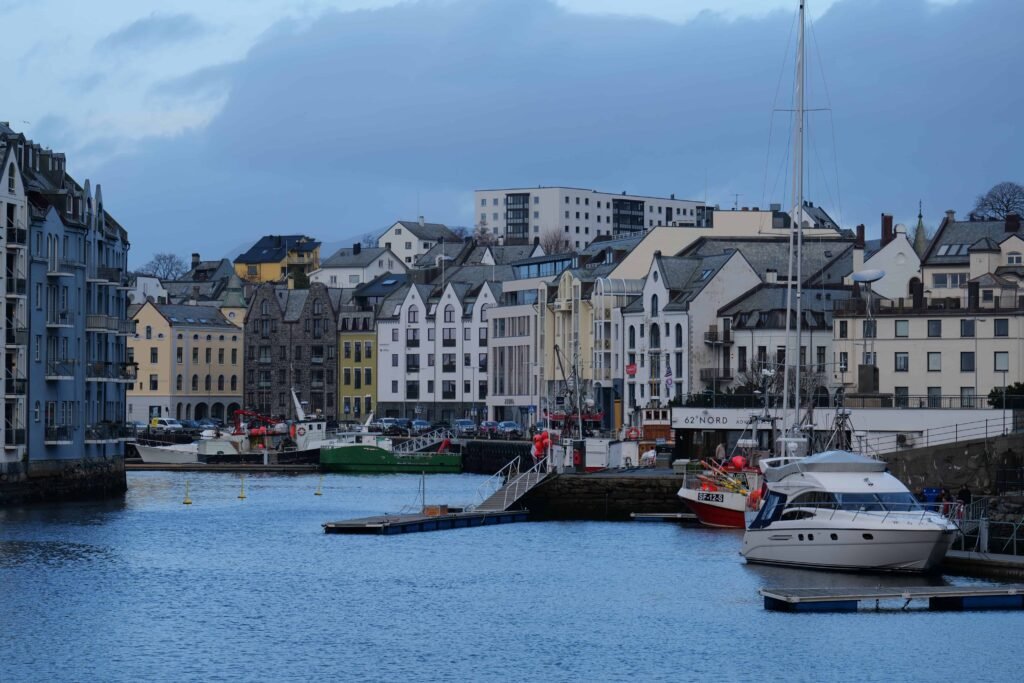
Alternatively, if you’re not travelling in the summer or autumn, you could also choose to do a Geirangerfjord excursion from Ålesund.
The Geirangerfjord excursion is a long, scenic day trip that takes you to one of Norway’s most iconic, UNESCO-listed fjords. (I was so sad to miss it on my voyage due to bad weather, but it’s definitely still on my bucket list!)
Molde: 10:35pm–11:05pm
Molde is your final stop of the day, and depending on the time of year, you might still be awake and have enough light to see it. But you won’t get off the ship here, as it’s only a 30-minute call.
The town of Molde sits in front of 222 mountain peaks, in a spectacular panorama called the Molde Panorama, which you will be able to see if you sail in summer.
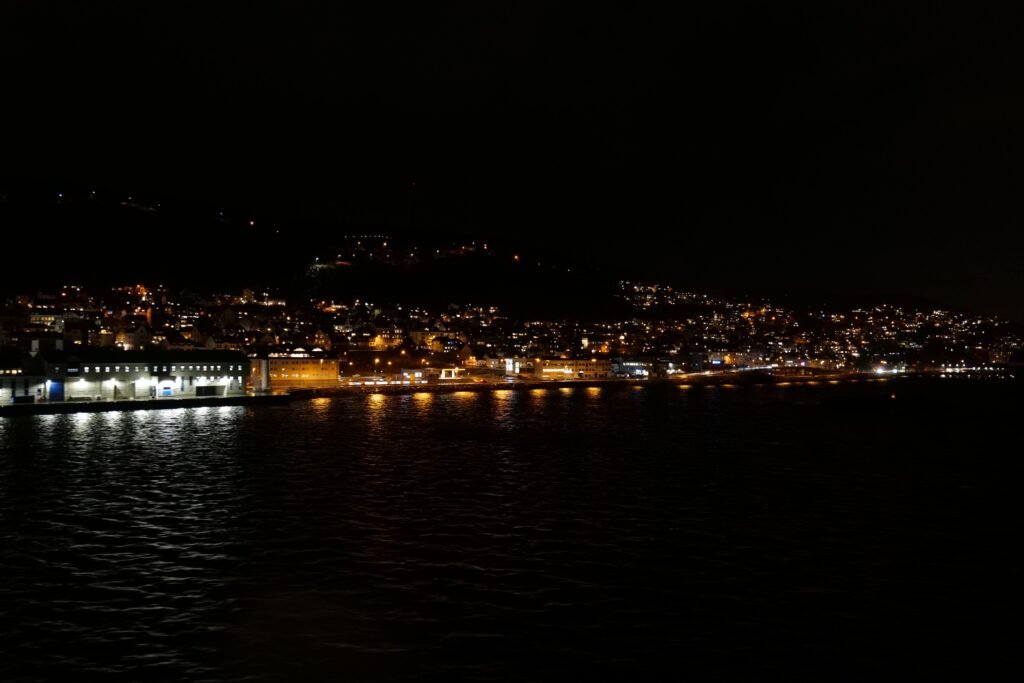
If you’re sailing in winter, there’s less reason to stay awake for this brief call, but the lights of Molde do reflect beautifully on the water in the darkness.
Day 3 – Norway’s Third City
Kristiansund: 2:45am–3am
Kristiansund is a colourful coastal town that sits across four islands. It’s best known for its picturesque harbour, famous Sundbåten Ferry, and long history with clipfish (salted cod).
You won’t see Kristiansund on the northbound leg, as the Norway coastal ferry service docks for just 15 minutes in the middle of the night.
But don’t worry about missing out! If you’re sailing the full round-trip, you’ll get a second chance southbound on day 11 to explore this beautiful Norwegian town!
Trondheim: 9:45am–12:45pm
Just before you dock, make sure you head out on deck (around 9:30am) to see Munkholmen island. It has a fascinating history as a former monastery, prison, and fortress, which you will learn about at the onboard daily briefing.
Shortly after, you’ll arrive in the colourful city of Trondheim (Norway’s former capital), which is a highlight of the Norway Coastal Express itinerary for many passengers.
However, on my voyage, the weather was awful!
Outdoor excursions were cancelled due to heavy rain, and exploring on foot would’ve just meant getting soaked and miserable for the sake of blurry photos.
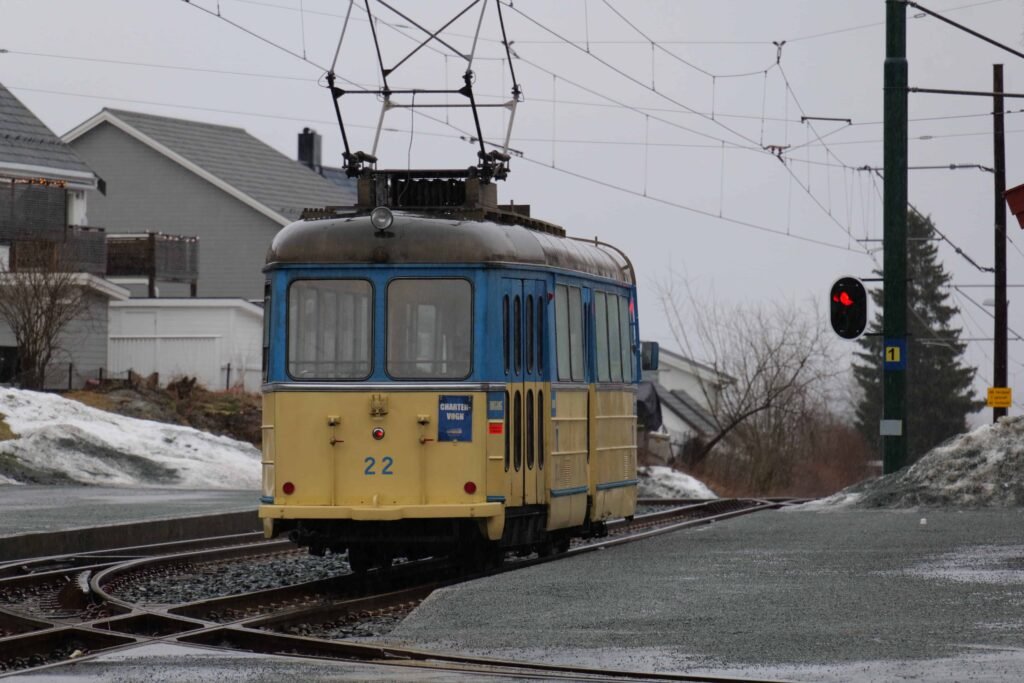
So I switched plans and joined Havila’s excursion on the northernmost tram in the world.
The vintage tram was charming, from the 1950s, and gave us a great overview of the city and nearby Lian.
Southbound though, I came back to Trondheim with better weather and finally got to explore on foot – and honestly, that’s where you’ll see the very best of this colourful city!
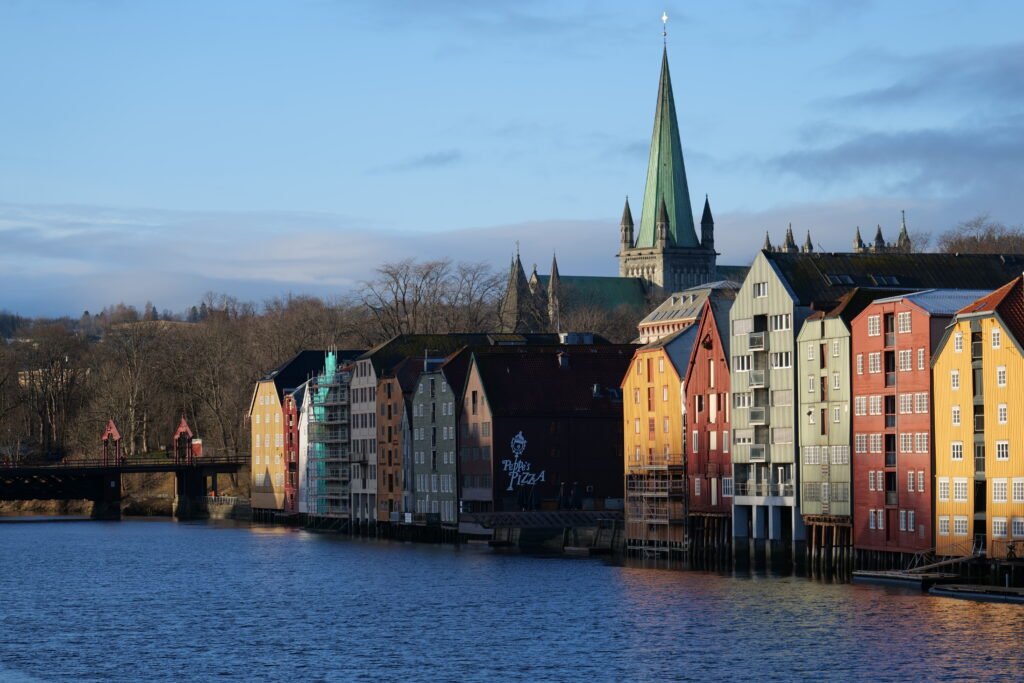
So, if the weather is on side, skip the excursions and just walk to the highlights like Bakklandet and Nidaros Cathedral, which are about 30 minutes from the port.
Katie’s Top Tip: If you’re exploring on your own, here is my full guide to the best things to do in Trondheim. It has everything you need to plan your route without wasting precious port time!
Afternoon at Sea
Once you leave Trondheim, the afternoon is spent at sea, and it’s a lovely stretch of Norway’s coastline!
As I said, we had awful rainy weather, but the scenery was still stunning. I spent most of the afternoon relaxing in the comfy panorama lounge on Havila’s deck 9, enjoying it all.
The scenery changes constantly throughout the whole voyage, so even if you’ve sworn you’re done taking photos for the day, trust me, you’re not!
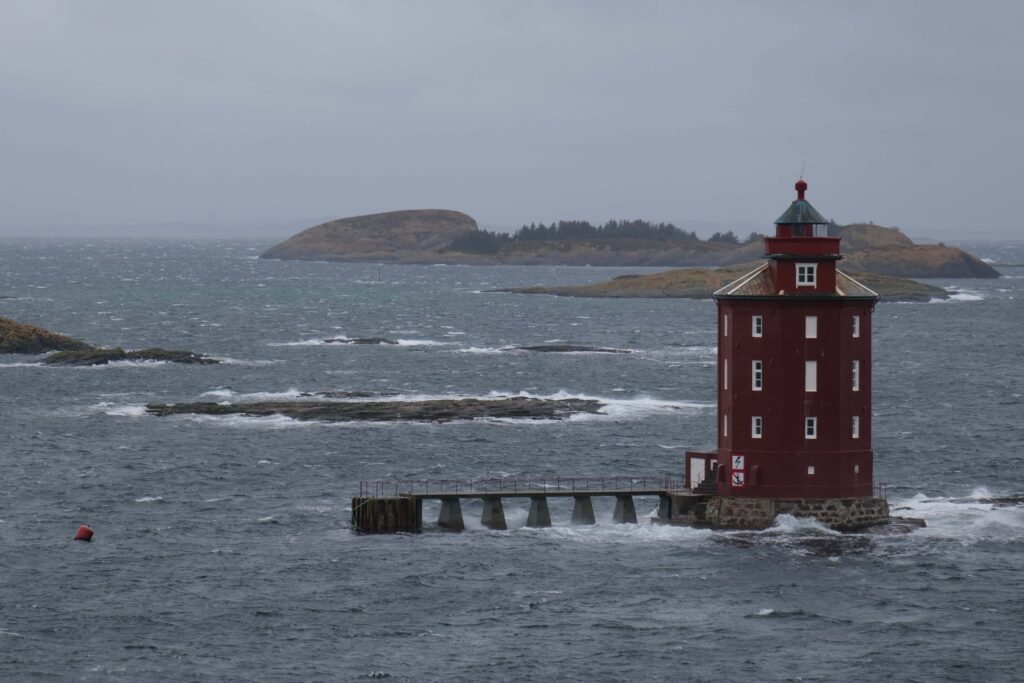
Also, keep a special eye out around 3:15pm for Kjeungskjaer Lighthouse, a bright red octagonal lighthouse that sits all alone at sea, on a tiny rocky islet.
Rørvik 9:40pm–10pm
Rørvik, in the Vikna archipelago, is a small coastal port town that again gives you a real sense of how important this Norway coastal ferry is to everyday life.
This port stop is too short to get off, at just 20 minutes, but you might still be awake to have a look out on deck or out of your cabin window.
At night in winter, the harbour lights reflected beautifully off the water!
Day 4 – The Arctic Circle
Brønnøysund: 1:35–1:45am
Brønnøysund is a small coastal town with a pretty, sheltered harbour, a picturesque church and a lovely lake that is perfect for a relaxing walk.
The northbound voyage calls in the middle of the night, for just 10 minutes, so you won’t be able to see any of this. But you will have the opportunity to explore this underrated town properly on the southbound leg of the voyage, where it is the main 2.5-hour stop of day 10.
Sandnessjøen: 4:35–4:50am
Sandnessjøen is a classic north Norwegian working port, acting as a transport, commercial and business hub for the entire region of Helgeland.
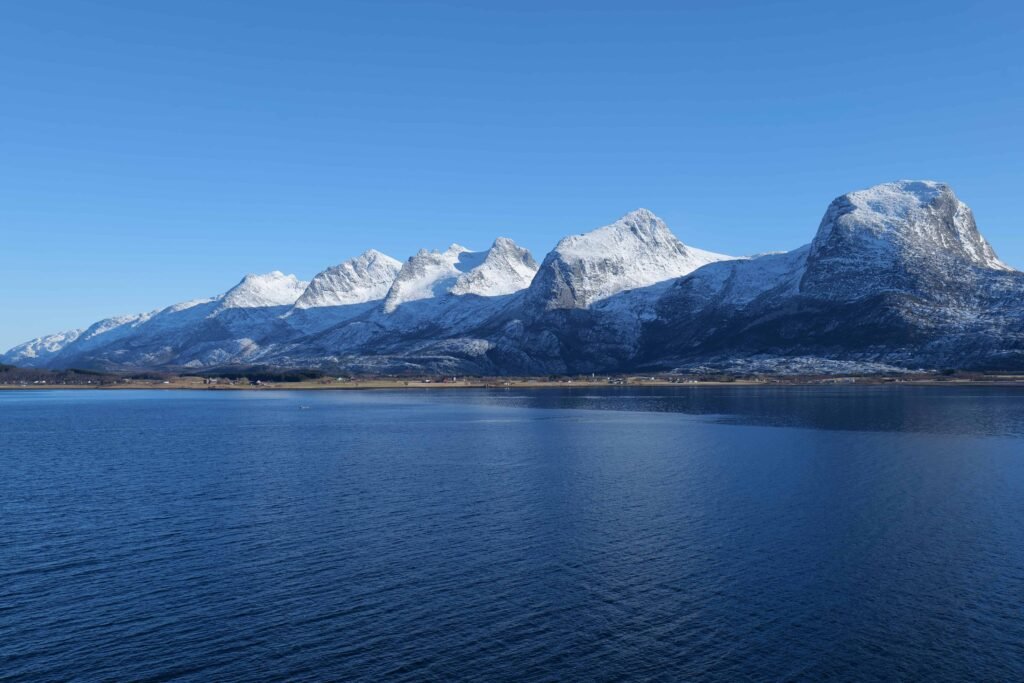
It’s surrounded by the famous Seven Sisters Mountain Range and some of the best coastal scenery in northern Norway (and the entire voyage!)
Of course, at this early hour, you likely won’t be awake (or have enough daylight) to truly appreciate this beautiful port, but you’ll pass through again during the day southbound.
Nesna: 6:00–6:10am
Nesna is another small, functional village port in Nordland county, and is used a lot by locals, the fishing industry and cargo.
It’s again surrounded by spectacular mountain and coastal scenery.
But you don’t need to worry about waking up at 6am to see Nesna, as you’ll sail back through in the late morning on the southbound voyage.
Crossing the Arctic Circle (around 7:30am)
The Arctic Circle is the southernmost latitude where the sun stays above or below the horizon for 24 hours at least once a year, giving you the midnight sun in summer and polar night in winter.
And this is one of those core moments on the Norway Coastal Express itinerary that will stick with you for a lifetime. Crossing the Arctic Circle is such a special experience!
The Arctic Circle crossing usually happens around 7:30am (ours was 7:40am), and you absolutely want to be on deck when it happens.
From the top deck, you’ll see the iconic Vikingen Globe marking the latitude line, and the captain will sound the ship’s horn as you enter the Arctic region.
Plus, the scenery is beautiful too. Make sure you look out for Hestmannen mountain, which, from some angles, looks like a knight on horseback.

Ørnes: 10am–10:10am
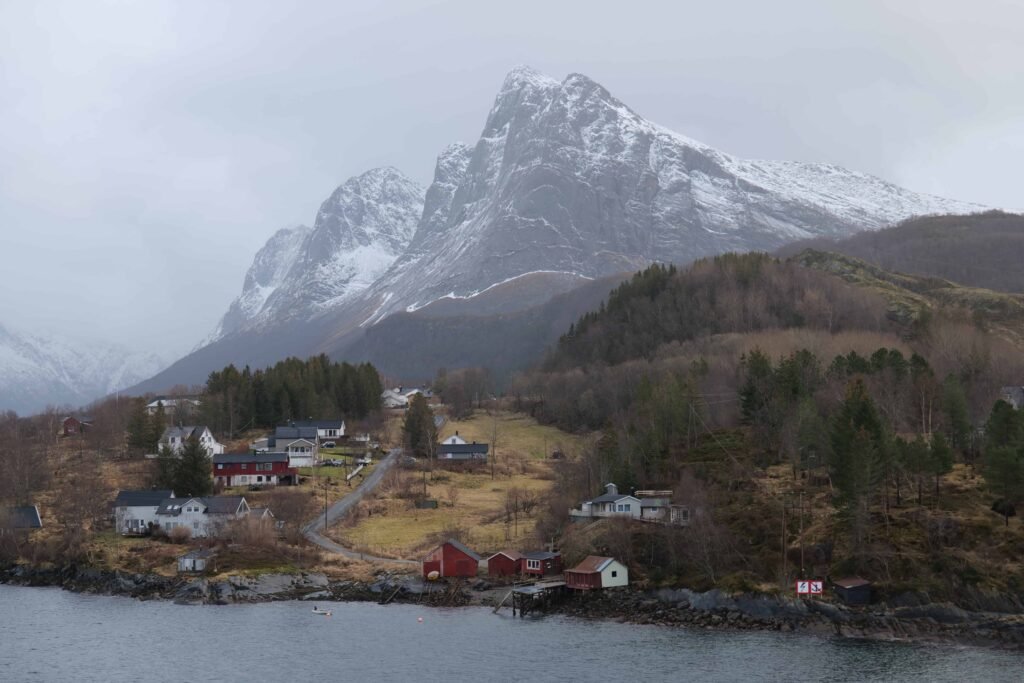
Ørnes is the first port of call after you’ve crossed the Arctic Circle. It is technically only a 10-minute stop, but it has some of the most spectacular scenery of all the tiny ports you visit.
You don’t have time to get off the ship here, but still make sure you head up to the deck for some of the best views of mountains, tiny islands, and quaint, colourful houses on this stretch of the Norway Coastal Express itinerary!
Then, just after leaving Ørnes, Havila holds the traditional Arctic Circle ceremony (usually at the outdoor bar on deck 8, weather permitting).
At the ceremony, they announce the winner of the Arctic Circle guessing competition, and then comes the traditional “ice dunking,” where brave passengers get a ladle of icy water poured down their backs!
Bodø: 1:05pm–3:20pm
Bodø, the capital of Nordland county, is the first major Arctic city on your route and your main port of call to get off and stretch your legs on day 4.
I’m gonna be honest, Bodø is definitely not Norway’s prettiest city (most of it had to be rebuilt after WWII, so it’s quite industrial), but the mountainous setting is still lovely.
You’ve got two main options when you arrive in Bodø: explore the city independently or join an excursion, like the Saltstraumen Tidal Current excursion.
If you’re exploring on your own, Bodø’s city centre is compact, with cafés, the harbourfront, and shops all within walking distance (perfect if you need to stock up on supplies!)
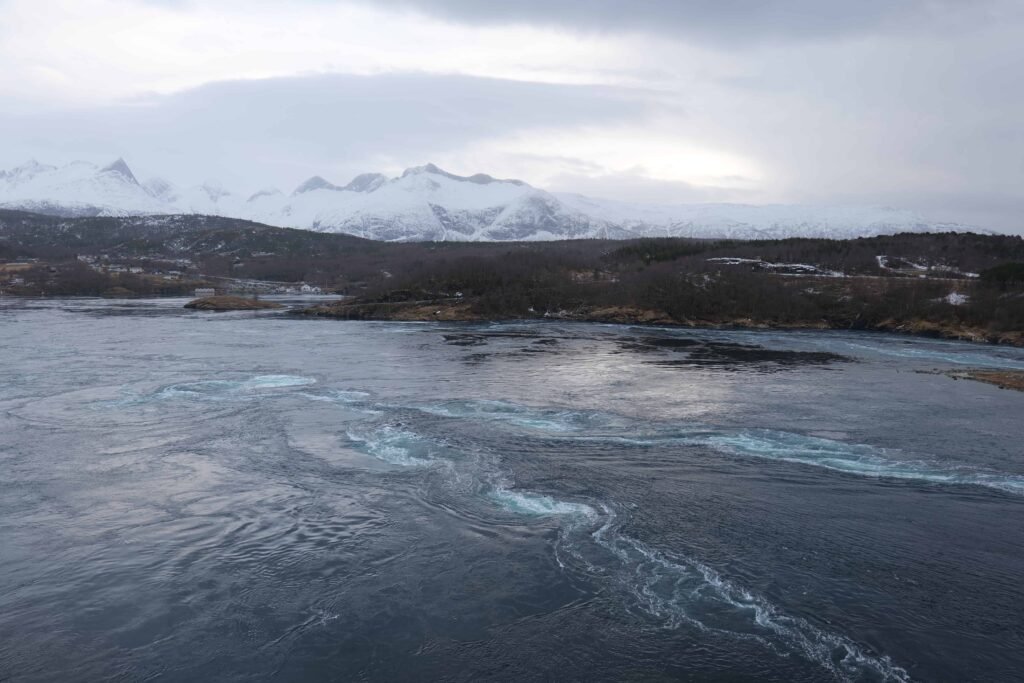
But if you want something truly unique, nearby Saltstraumen is home to the world’s strongest tidal current.
I booked this excursion with Havila, and it was such a cool experience to see the powerful water swirling beneath my feet!
But my advice is that you definitely shouldn’t book it in advance. Wait until the expedition briefing the day before, to check if the current will be strong. If not, save your money.
Katie’s Top Tip: As you sail out of Bodø, head to the right-hand side of the ship for a great photo opportunity of Nyholmen Skandse, an 18th-century fortress.
Stamsund: 7:15pm–7:40pm
Arriving in the Lofoten Islands feels magical, even in the dark!
Stamsund is a tiny but beautiful fishing village, with colourful houses and dramatic mountains rising from the water.
It’s only a short stop, but it’s still a great opportunity for photos from the top deck, or you might be leaving here to join an excursion that rejoins the ship in Svolvaer.
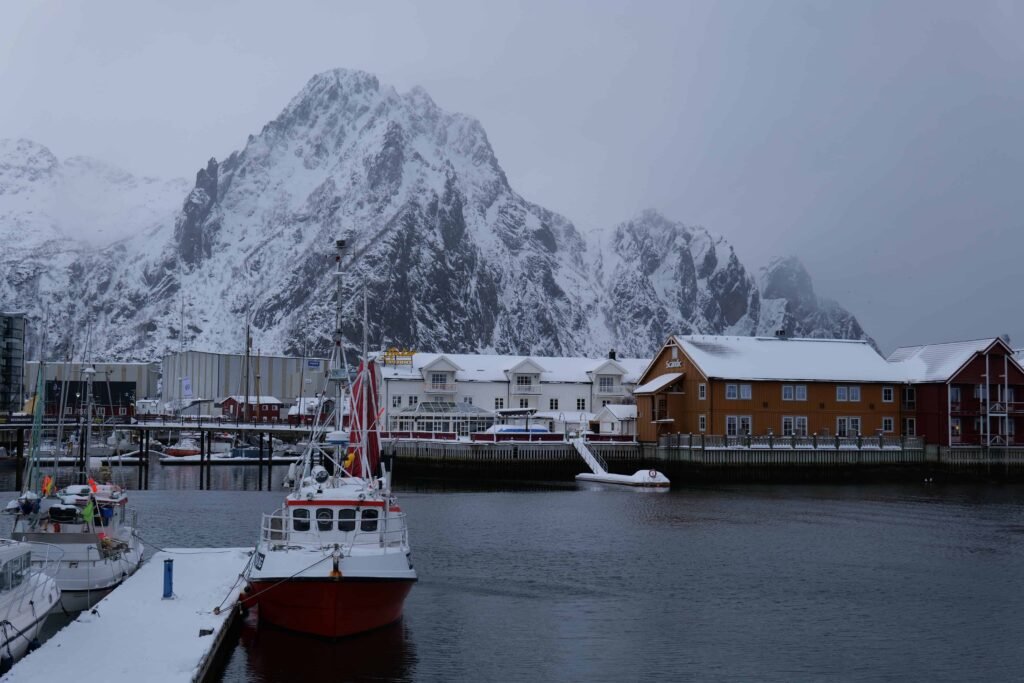
Svolvaer: 9:20pm–10:15pm
Beautiful Svolvaer is the capital of the Lofoten Islands and a much larger port than Stamsund.
If you’re not too tired after dinner and a long day of cruising, you can absolutely hop off in Svolvaer for a quick walk around the harbour.
The area around the port is compact, well-lit, safe, and very beautiful to explore all year round. (Even in the winter, when it’s dark, you’ll still see the lights reflecting off the water.)
Or, if you prefer to stay on board, the views from the top deck are just as lovely.
Then, later on, at around 11:15pm, your ship sails through Raftsund.
In theory, this is one of the most beautiful stretches of the entire Norway Coastal Express itinerary, but if you’re travelling in winter, it’s too dark to see anything.
You can stay up for it if you want, but your ship will sail back through the picturesque Raftsund during the day on the southbound voyage, so you won’t miss out!
Katie’s Top Tip: This is also when a fun “Trolldrink” ceremony is held on board. You get a hot apple juice or cider in a mug to celebrate your arrival at the Raftsund with your fellow passengers – and you get to keep the mug afterwards as a souvenir! You can book in the restaurant earlier in the day, and I would highly recommend it!
Day 5 –The Heart of the Arctic
Stokmarknes: 1:30am–1:40am
The town of Stokmarknes is a functional working port and the birthplace of the Coastal Express, but on the northbound sailing, you won’t arrive here until the middle of the night (and only for 10 minutes).
But don’t worry about missing out. The Coastal Express will return to Stokmarknes southbound, this time for an hour, where you’ll have the chance to visit the fascinating Hurtigruten museum.
Stortland: 2:55am–3:10am
Next, the Norway Coastal Express calls at the town of Sortland in Nordland county, again in the middle of the night for just 15 minutes.
This overnight stop is for cargo and local ferry passengers, but you’ll return in daylight on the southbound voyage to see the beautiful blue buildings this town is famous for!
Risøyhamn: 4:35am–4:50am
The final overnight stop for day 5 is the village of Risøyhamn – a tiny community with only 200 inhabitants that call it home. This is Hurtigruten and Havila’s smallest port of call.
You’ll get far better views of the surrounding landscapes and the famous Risøy Channel on the southbound sailing.
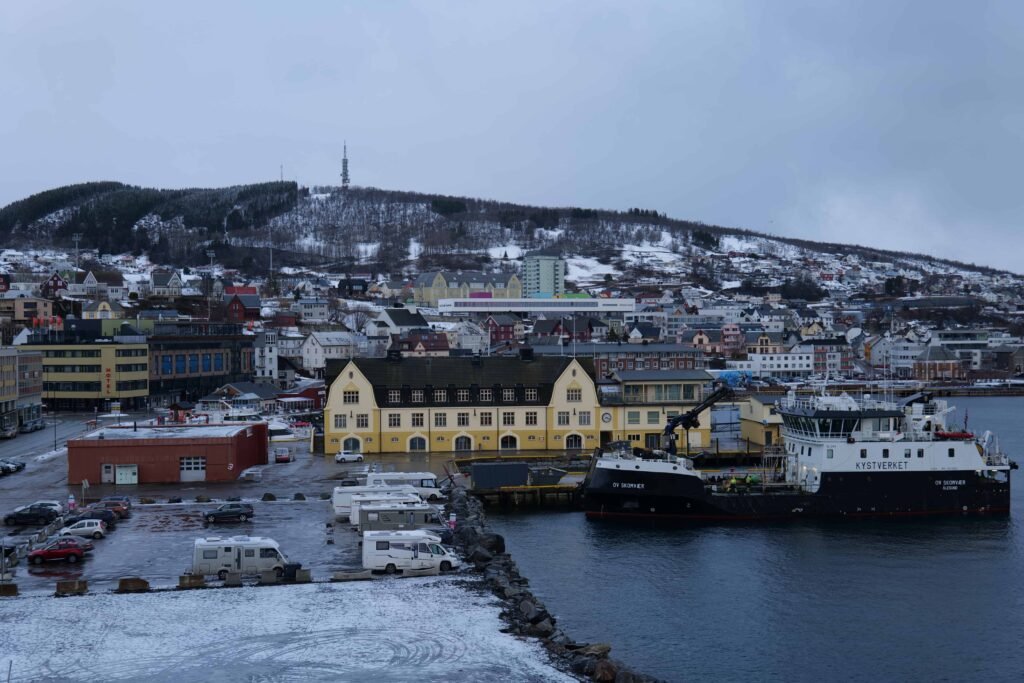
Harstad: 7:10am–7:45am
Harstad, located on Hinnøya island in Troms county, is your first real chance to step outside and explore today, if you’re up early enough.
Even with only 35 minutes in port, you have enough time for a quick walk around the harbour area if you want to stretch your legs before breakfast.
Or, you can just admire this small city from the deck.
Finnsnes: 11am–11:30am
Finnsnes is a town in the municipality of Senja, located on the Gisundet Strait, and is your last port of call before reaching one of the highlights of the voyage: Tromsø!
This small town has some of the most spectacular scenery on day 5, as it sits right next to the bridge connecting Senja (one of Norway’s prettiest islands) to mainland Norway.
Even though you won’t be docked for long, it’s worth heading out on deck for that iconic view of the bridge crossing the strait, with mountains towering in the background.
The 30-minute port call is also enough time to leave the ship for a short walk around Finnsnes harbour, if you want to stretch your legs.

Tromsø: 2:15pm–6:15pm
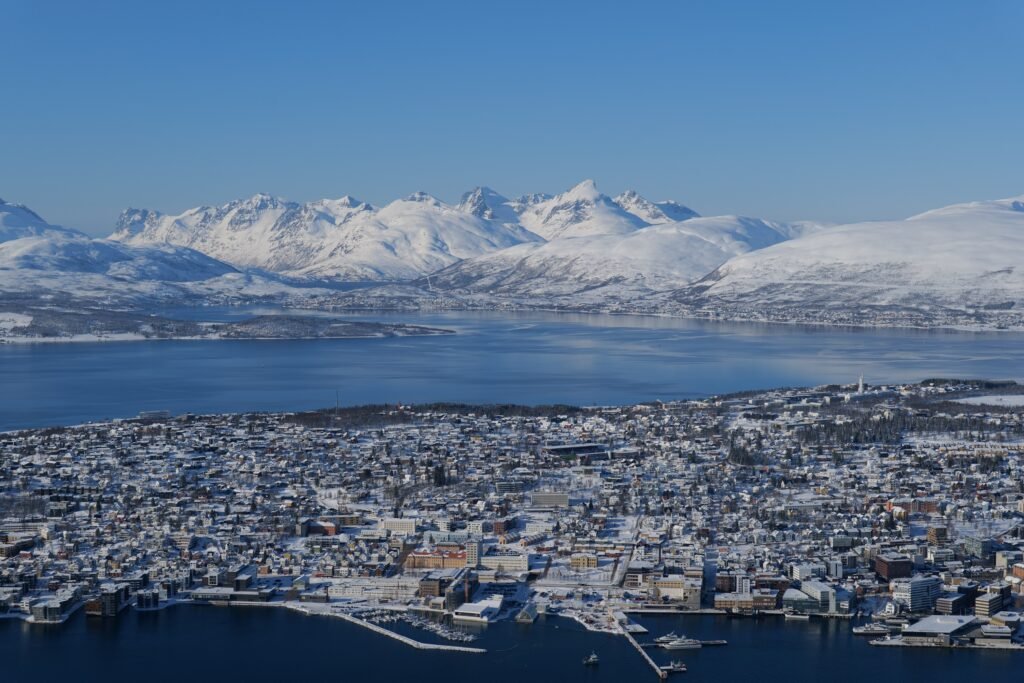
Tromsø is the true star of day 5 (and a highlight for many passengers of the entire voyage!) You’ll get a four-hour port stop, which is plenty of time to experience the best things to do in Tromsø.
A lot of travellers book shore excursions here, for example, reindeer sledding or husky sledding. But honestly, I think Tromsø is one of the easiest cities on the Norway Coastal Express itinerary to explore solo, and you’ll get more freedom (and save money!) this way.
What to do in Tromsø?
Start your afternoon in Tromsø with a walk around the colourful harbour and streets around Storgata and Tromsø Cathedral. There are also lots of cosy cafés here.
Then continue across the iconic Tromsø bridge (either on foot or by bus) to explore the striking Arctic Cathedral and take a ride on the Fjellheisen cable car.
At the top, you get sweeping views of this stunning island city, the surrounding mountains, and the fjords beneath your feet. And you’ll also see your ship!
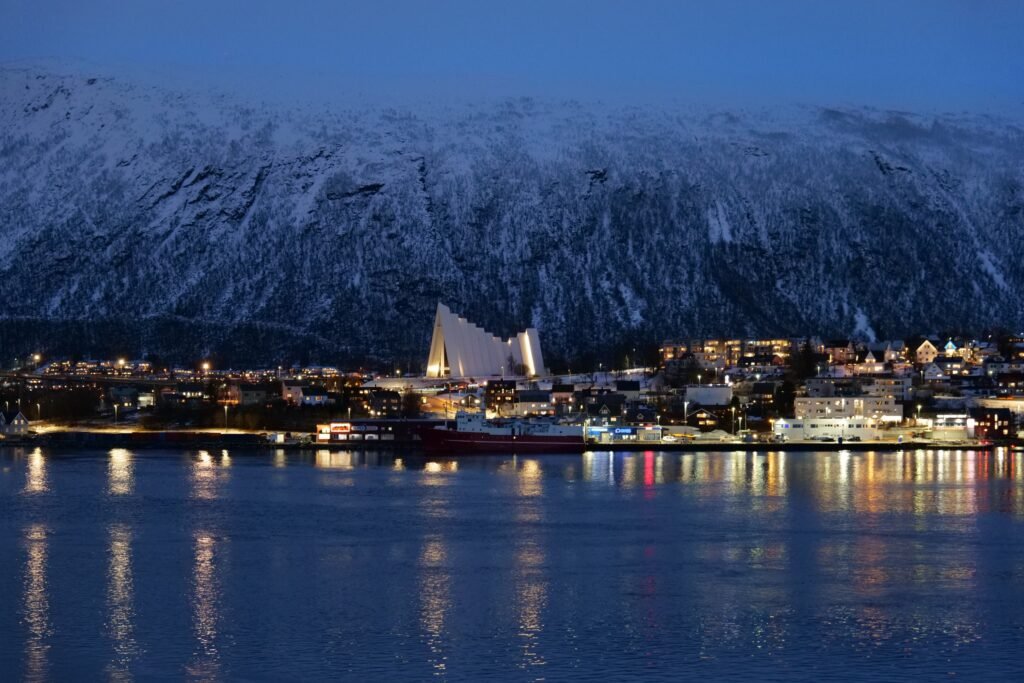
Katie’s Top Tip: When you return to the ship, don’t head straight inside. Tromsø’s departure was one of my favourite moments of the entire Norway Coastal Express itinerary! As you sail away, the Arctic Cathedral glows against the mountains, and the city lights reflect in the water.
Skjervøy: 10:10pm–10:25pm
To end day 5 of the voyage, your ship will make a brief port call at the tiny island village of Skjervøy, in the late evening.
If you’re awake, it’s lovely to go out on deck or watch out of your cabin window and see the village surrounded by the steep mountains of the Lyngen Alps.
Day 6 – Norway’s Northernmost Point
Øksfjord: 1:50am–2am
Øksfjord is a small fishing village in Finnmark county, surrounded by majestic mountains and the mighty Øksfjord glacier, which were covered in snow when I visited in winter.
You’ll dock here again in the daytime (on my sailing, it was around sunset) on the southbound leg, so you’ll be able to see the coastline and surrounding peaks properly then!
Hammerfest: 5:05am–5:45am
Norway’s northernmost town was rebuilt after a fire in 1890, and now has a modern waterfront, a distinctive church, and famous energy infrastructure nearby that powers much of the region.
Hammerfest is a bigger, more popular port on the Norway Coastal Express itinerary, but don’t worry that you’ll be missing out. There is a longer daytime call to explore the town on the southbound voyage.
Havøysund: 8:30am–8:45am
For me, the small town of Havøysund was one of the most surprising port stops on the entire Norway Coastal Express itinerary!
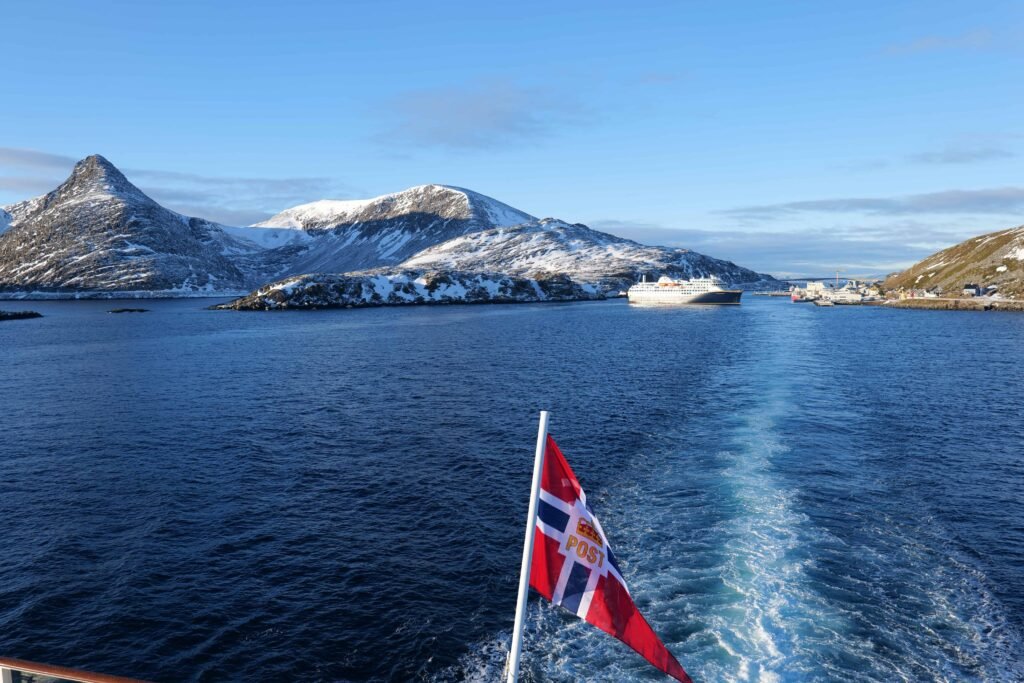
Havøysund sits between rugged cliffs and islands, with colourful houses, a quaint harbour, and tiny fishing boats bobbing in the water. It’s genuinely picturesque and well worth the early wakeup call to get out on deck for some photos!
From the deck, the best photo spots are on the right-hand side as you approach, or the back of the ship as you depart, as you’ll get a full view of the town and bridge, framed by the beautiful cliffs.
Plus, as we were leaving, we port-switched here with our sister ship, Havila Castor.
The crew even arranged for us to all wave flags as both ships swapped places in the tiny harbour, which was such a special, unexpected moment on the voyage!
Katie’s Top Tip: Come back out on deck at around 9:45–10am, as you sail through the Magerøysundet strait. This is one of the most scenic stretches of the voyage: a narrow corridor of water between steep mountains and the island of Magerøya.
Honningsvåg: 10:55am–2:30pm
Most passengers choose to join the North Cape excursion from Honningsvåg, your longest and northernmost port of call on day 6 of the Norway Coastal Express itinerary.
I personally did visit North Cape (even though I was unsure whether it was worth it), and honestly? It surprised me how much I loved it!
If you’re planning to book this excursion, definitely read my guide Is North Cape Worth Visiting? because it shares what to expect and how to make the most of your time there.
Then, once you’re back from the excursion, make sure you head straight outside to appreciate beautiful Honningsvåg itself, as the Coastal Express prepares to leave port.
This small, Arctic community is stunning, with colourful houses sitting at the base of dramatic, snow-topped hills, and a picture-perfect harbour dotted with fishing boats.
Plus, the views leaving this small port are some of the best of the entire northern section of the Norway Coastal Express itinerary!

Kjøllefjord: 4:40pm–5pm
You can’t disembark in Kjøllefjord because the stop is too short, but trust me, you’ll want to be outside for this one!
The fjord is narrow, dramatic, and framed by mountains that are covered in snow in winter. And the village is tiny, with colourful houses and traditional fishing boats in the harbour.
Plus, when we arrived in the late afternoon, we were treated to the most spectacular, vivid Arctic sunset of the entire voyage!
It’s one of the most charming Norwegian ferry ports on the route, and the entrance to the fjord is spectacular, so I was shocked more people weren’t out on deck here.

Mehamn: 6:55pm–7:15pm
Mehamn is a small fishing community and ex-whaling settlement on the far northeastern tip of Norway. (This is another spot famous for rough open seas, so if you need to, take seasickness tablets.)
At this point in the evening, most passengers are heading to dinner (and I was too!), so you’ll probably only be admiring the lights of this tiny port from the restaurant.
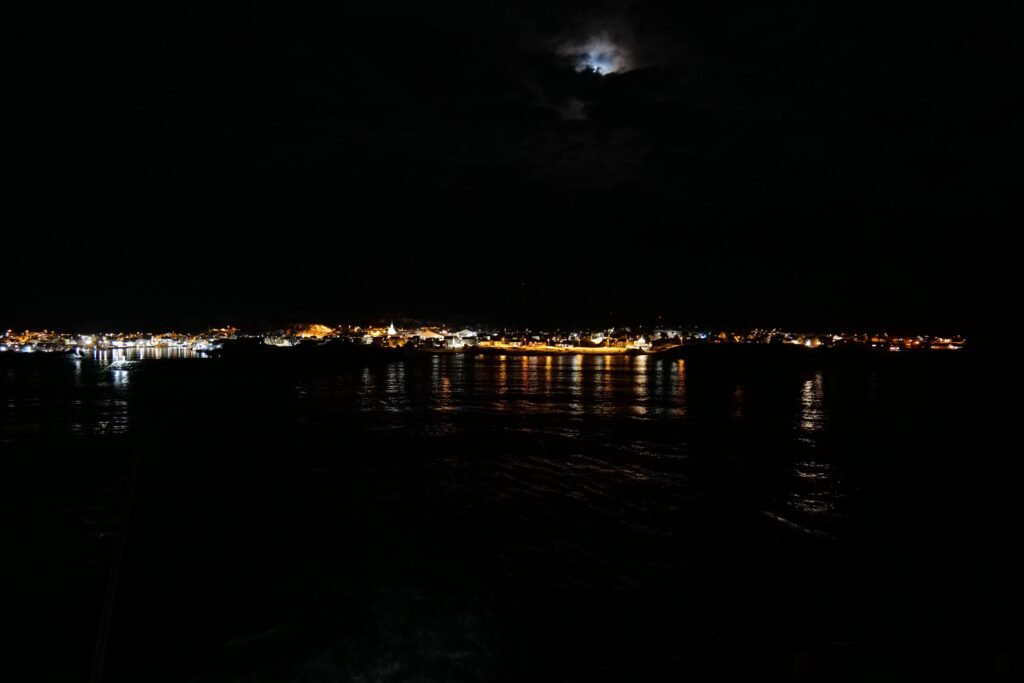
Berlevåg: 10pm–10:10pm
Berlevåg is another short, evening port of call that we visited in darkness on my winter voyage. It is one of the most isolated communities you visit on the entire route.
When we docked, the harbour was lit up, with the lights reflecting in the dark waters.
Katie’s Top Tip: If you’re hoping to spot the northern lights, Berlevåg is one of the best ports to pop out for a sky check! Our ship spotted them here for the first time, just after leaving port.
Day 7 – The Turning Point of the Voyage
Båtsfjord: 12am–12:30am
The small port of Båtsfjord is actually one of the largest working fishing ports on the Varanger Peninsula, but at this late hour, you won’t get to experience it.
Vardø: 3:30am–3:45am
If you love a fact, I have a fun one: Vardø is the easternmost town in Norway, and actually sits further east than Istanbul and St Petersburg!
The Norway Coastal Express docks at this tiny, remote port in the middle of the night for just 15 minutes and because of this, you won’t have the chance to explore.
But, later in the afternoon, the southbound voyage will call here again.
Vadsø: 6:55am–7:10am
By early morning, you’ll reach the small community of Vadsø, famous for its birdlife.
If you’re up early, you can head out to see this short port of call and get a sense of just how remote and stark the landscapes are up here, compared to where you have been so far.
This port is only a stop on the northbound voyage, so if you wish to see Vadsø, you will have to get up early for it.
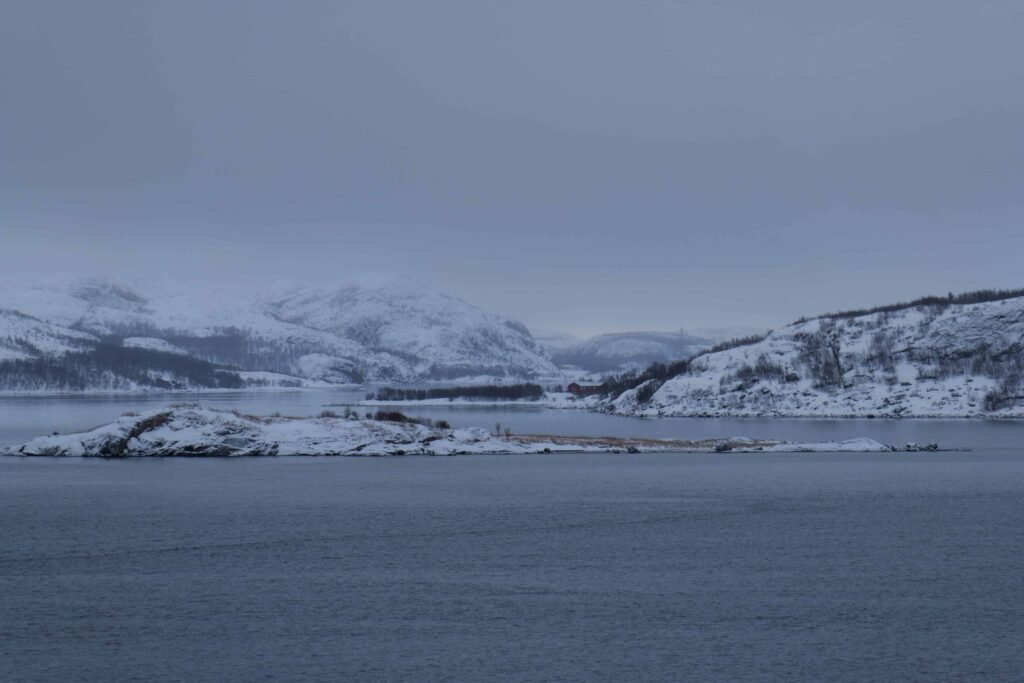
Kirkenes: 9am–12:30pm
Kirkenes, close to the Russian border, is where the route quite literally turns around!
The scenery surrounding Kirkenes looks dramatically different to anything you’ve seen on the voyage so far. It’s flatter, harsher and very bleak – but also a fascinating contrast!
It’s well worth getting up on deck for some photos on the approach.
For passengers only doing the northbound stretch, this is the final stop before heading home, so if you’re staying, you’ll find that the ship is quieter on the southbound leg.
And if you are on the full round-trip, this is the perfect port to join a true Arctic excursion!
I personally did the husky sledding, reindeer feeding and Snow Hotel excursion with Havila, and it was one of the highlights of my entire 3-week trip to Norway!
But alternatively, if you don’t fancy an excursion, Kirkenes itself is a fascinating town to explore, with strong Russian influences (you’ll get a sense of this from the street signs, in both Russian and Norwegian).
Katie’s Top Tip: If husky sledding is on your bucket list, book early, as this is one of the most popular excursions on the entire itinerary. It sold out on my voyage, and our ship wasn’t even full.
Vardø: 4:05pm–5pm
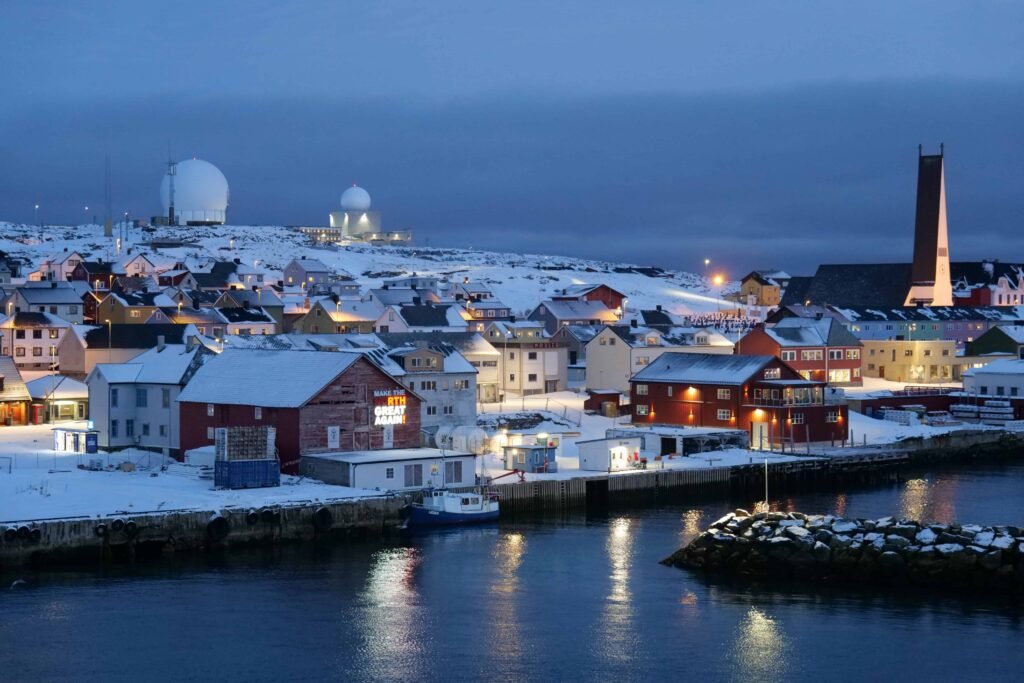
Sailing back into Vardø later in the day gives you a chance to take some photos after the brief northbound night-time stop.
By late afternoon on our voyage, the sun was setting, and dusk was falling, and Vardø was incredibly photogenic!
The colourful houses, striking church and traditional fishing boats all made for some incredible photo opportunities of one of Norway’s most remote communities.
You’ll also have enough time to get off for a short walk here if you wish, but honestly, some of the best views are from the top deck.
Båtsfjord: 8:00pm–8:30pm
Your evening return to Båtsfjord feels very different from the midnight arrival earlier.
The harbour is busy, with fishing boats unloading and plenty of activity in the port. This stop gives you a real-life look at the working Arctic coast, which I personally found fascinating!
And, if you head out on deck, you’ll see the bright lights of the village climbing up the hillside, which is especially atmospheric in winter, when everything is dusted with snow.
Berlevåg: 10:25pm–10:35pm
Berlevåg is a tiny, rugged harbour that is protected by enormous tetrapods (huge concrete breakwaters) that break the waves.
When we arrived in winter, the entire village was glowing under the streetlights, and we actually ended up seeing the Northern Lights for the second time, just after leaving port!

Day 8 – Norway’s Northernmost Town
Mehamn: 1:20am–1:30am
Mehamn is one of the northernmost fishing villages in Norway, known for its small harbour, rugged coastline, and unique Sami heritage.
You already visited Mehamn in the early evening on the northbound route, so this second port call is just a quick nighttime stop for cargo and passengers.
Kjøllefjord: 3:25am–3:35am
Kjøllefjord is a traditional fishing community on the Nordkyn Peninsula. Again, it has a strong Sami culture and views towards the iconic Finnkirka sea cliff.
This is your ship’s second time calling here, and the late afternoon northbound stop was when you had the opportunity to see this beautiful fjord village and the surrounding coastline properly.
Honningsvåg: 5:45am–6am
Honningsvåg is one of the more recognisable Norwegian ferry ports on this route because it’s the gateway to North Cape.
On the southbound stretch, though, you’re only here for a quick call in the early morning, so you won’t get to see it again unless you’re an early riser.
Havøysund: 8am–8:15am
Havøysund is one of the only ports you’ll get to experience twice in daytime on the Norway Coastal Express itinerary – and it’s so beautiful it’s worth heading out on deck again to see it!
The approach to this picturesque community is stunning, with the colourful houses that surround the harbour sitting between dramatic rocky hills (that are snow-covered in winter).
On my sailing, we had another port switch with the northbound Hurtigruten ship. Watching both ferries manoeuvre in such a small port was fascinating!
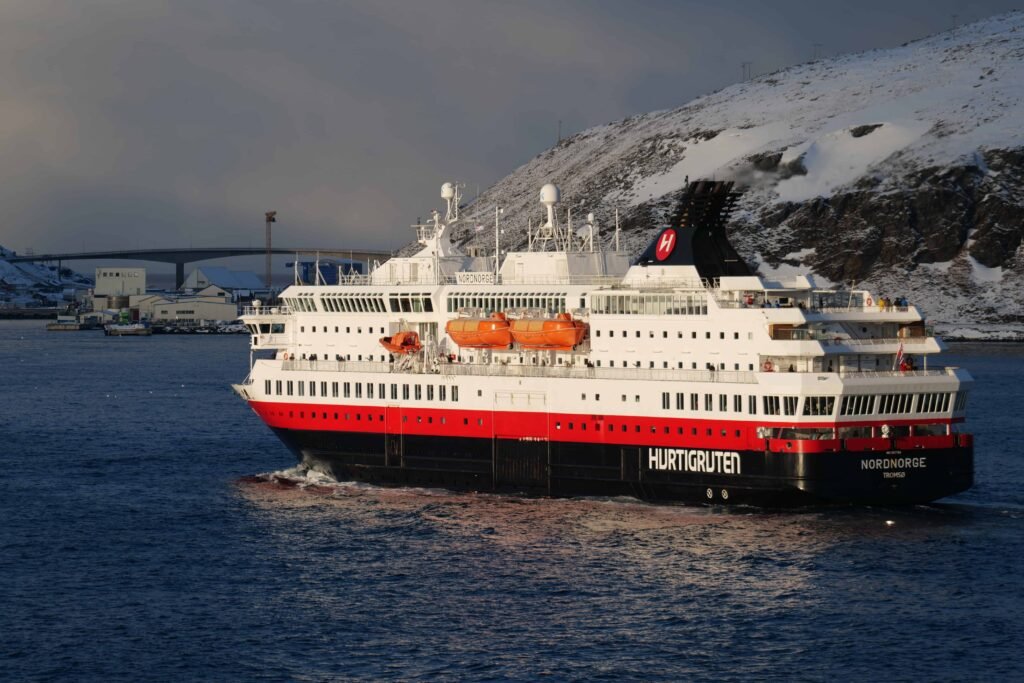
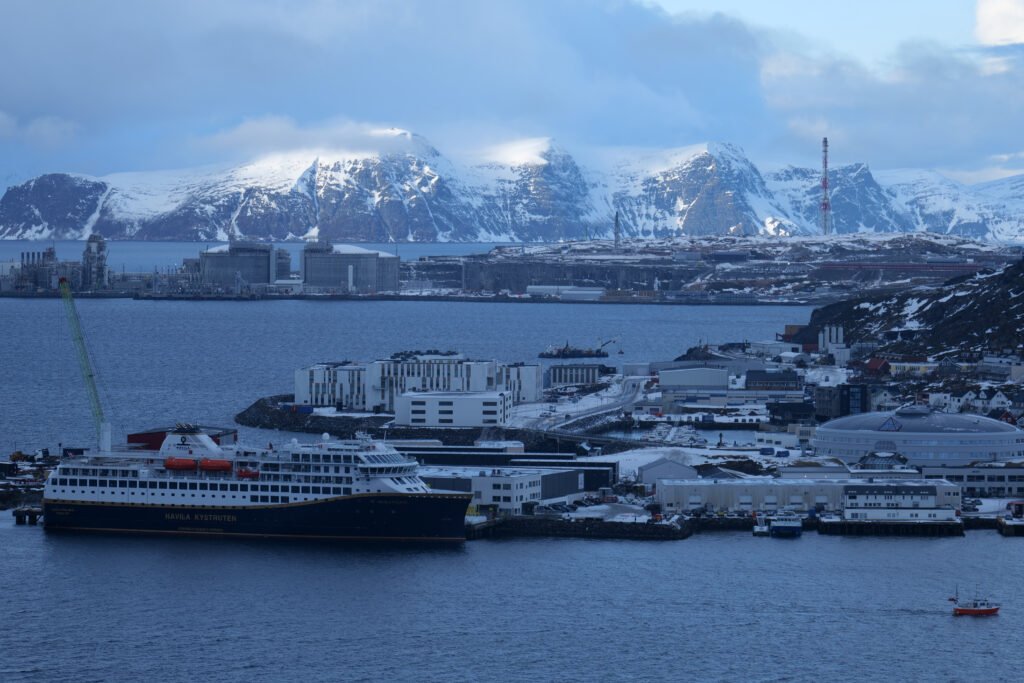
Hammerfest: 11am–12:45pm
Just before you arrive in Hammerfest, at around 10:30am, you’ll pass by Melkøya.
It’s an industrial island that’s home to a major LNG plant. So it’s not exactly pretty (or a typical photo op!), but it’s a big part of modern Arctic Norway, and I found that fascinating.
When you dock, you’ll be in Norway’s northernmost town, Hammerfest, which is one of the major highlights on the southbound route.
Hammerfest is a modern, industrial town that is so different to the rest of the stops on the voyage – but that’s what makes it so interesting to get off and explore.
From where the Norway coastal ferry service docks out of the centre, the actual town of Hammerfest isn’t easy to explore independently.
So, if you want to make the most of your time here, I recommend the organised excursion
It takes you on a bus tour through the town itself, up to the iconic Polar Bear viewpoint (with amazing views across the harbour, mountains and your ship), and then to the UNESCO-listed Meridian Column.
If you decide to explore independently, the Meridian Column is realistically the only attraction you can reach on foot with the limited time you have.
Øksfjord: 3:50pm–4:05pm
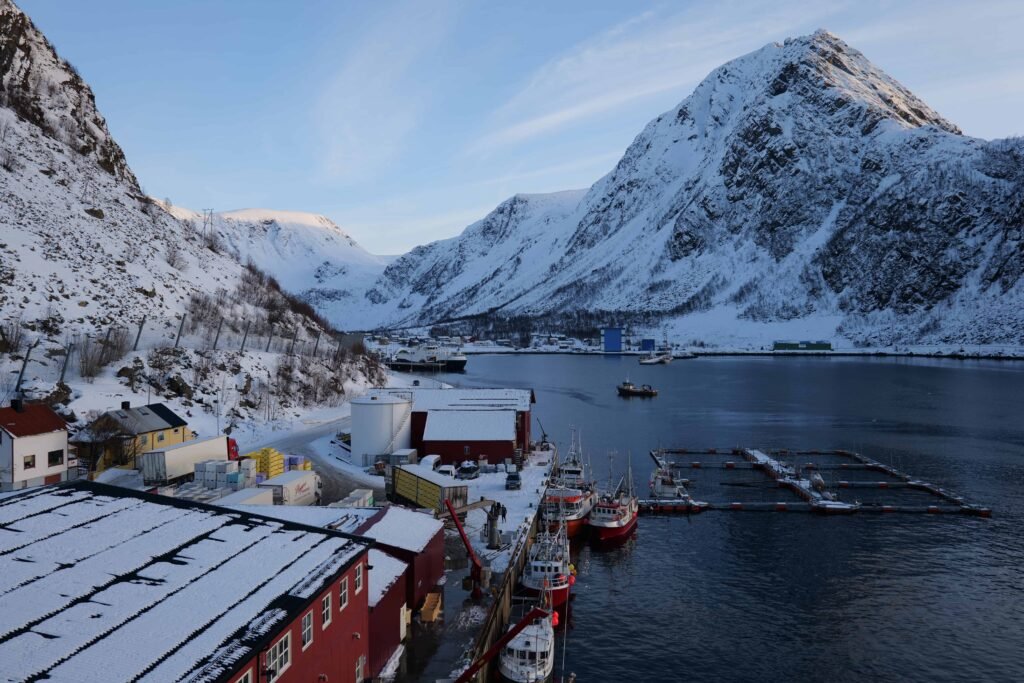
Even with only 15 minutes docked in Øksfjord, it’s worth getting out on deck to take some photos and admire the scenery!
This tiny settlement sits at the base of dramatic mountains, and in winter, the whole landscape is covered in thick, untouched snow.
Øksfjord actually ended up being one of my favourites of all the tiny Arctic ports we visited, especially as you’d never get to see it unless you’re on this route!
The harbour is small but beautiful, with traditional fishing boats, brightly coloured houses and, in winter, even snowmobiles parked near the port!
Katie’s Top Tip: For the best photos of Øksfjord, head to the very back of the ship as you depart. The view of the mountains fading behind you is just incredible!
Skjervøy: 7:30pm–7:45pm
Skjervøy is your next port of call, and depending on the time of year, you might get to see it in daylight. But for my winter sailing, it wasn’t any different to seeing it in darkness northbound.
The harbour itself is practical and busy, with a strong fishing culture, and I most loved watching the lights from the houses reflect in the water.
Tromsø: 11:45pm–1:30am
This may be a late port call (and you will have done your main exploring northbound), but the ship docks close enough to the centre that you can walk into town if you wish.
Even in winter, I saw plenty of fellow passengers heading off for a walk, and Tromsø centre itself was surprisingly busy.
And in summer, the Midnight Sun makes Tromsø a magical place to stay up for.
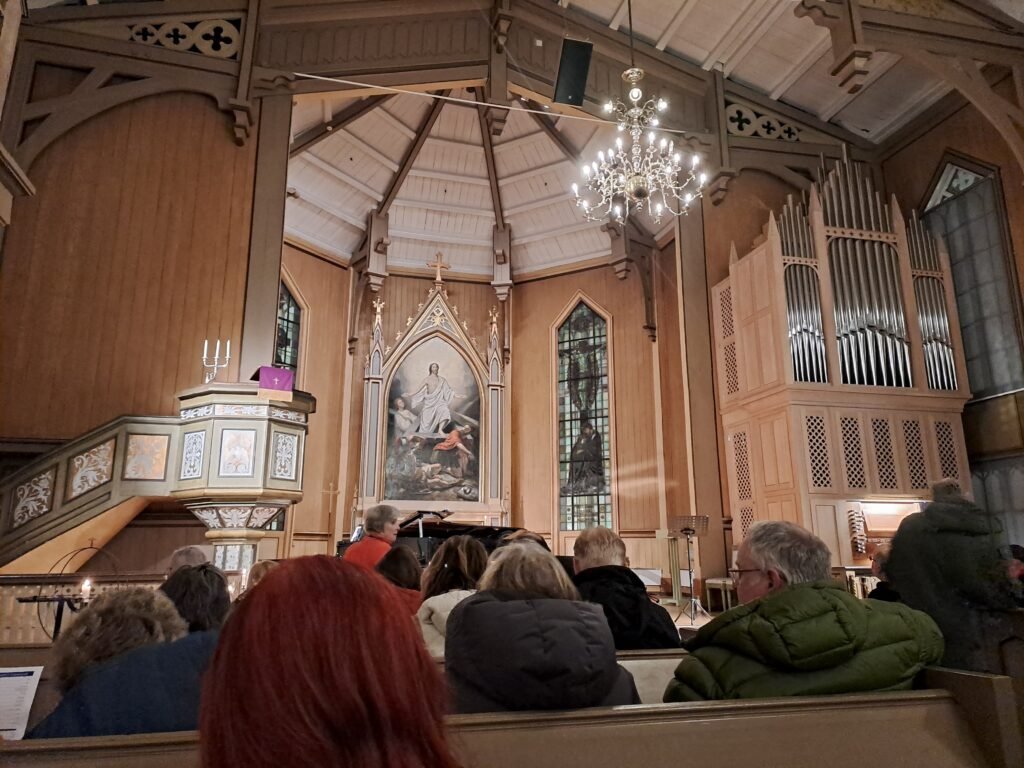
I personally attended the midnight concert in Tromsø Cathedral on this port call, and absolutely loved it!
Day 9 – Vesterålen and The Raftsund
Finnsnes: 4:20am–4:40am
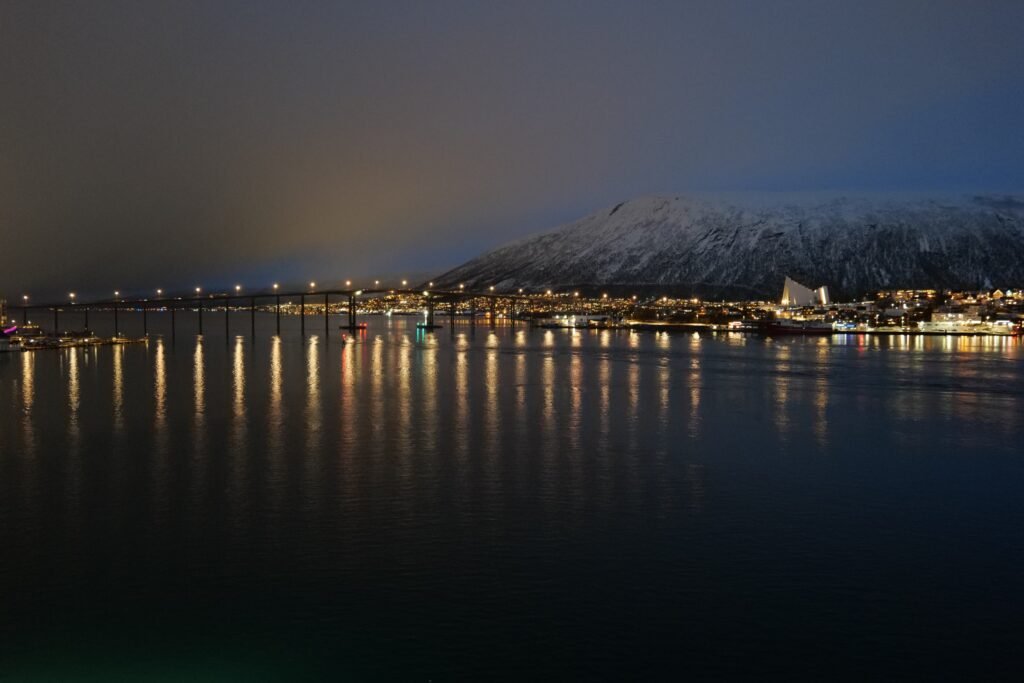
The ship leaves Tromsø at 1:30am, and if you’ve been out and about, it’s worth staying up a bit longer for sailaway. I loved the way the lights reflected on the water as we departed – and the Arctic Cathedral is all lit up too!
Then, in the early hours, you’ll arrive in Finnsnes, a small but busy transport hub in Troms county. It’s connected to the island of Senja by the Gisund Bridge, which you’ll already have seen during the northbound voyage.
Harstad: 8am–8:30am
By 8am, you’ll reach Harstad, another town on the Norway Coastal Express itinerary that you can see both on the northbound and southbound legs of the voyage.
Most people overlook Harstad, but the town is still well worth seeing.
You have time for a quick walk around the harbour area here, or you can just head to the top deck for some early morning photos.
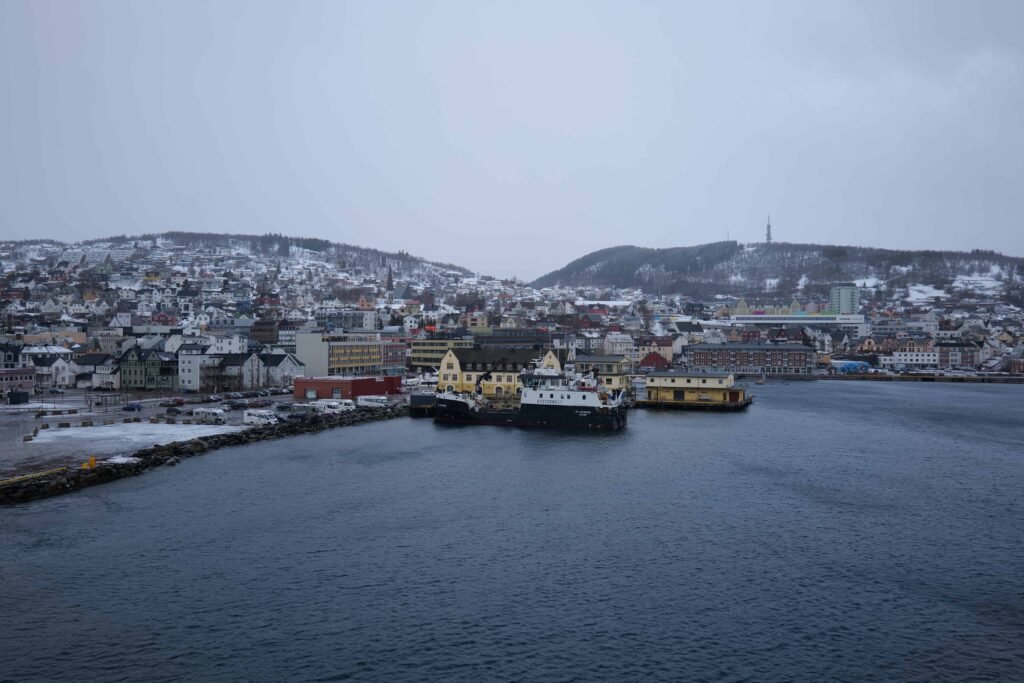
Risøyhamn & The Risøy Channel: 10:45am–11am
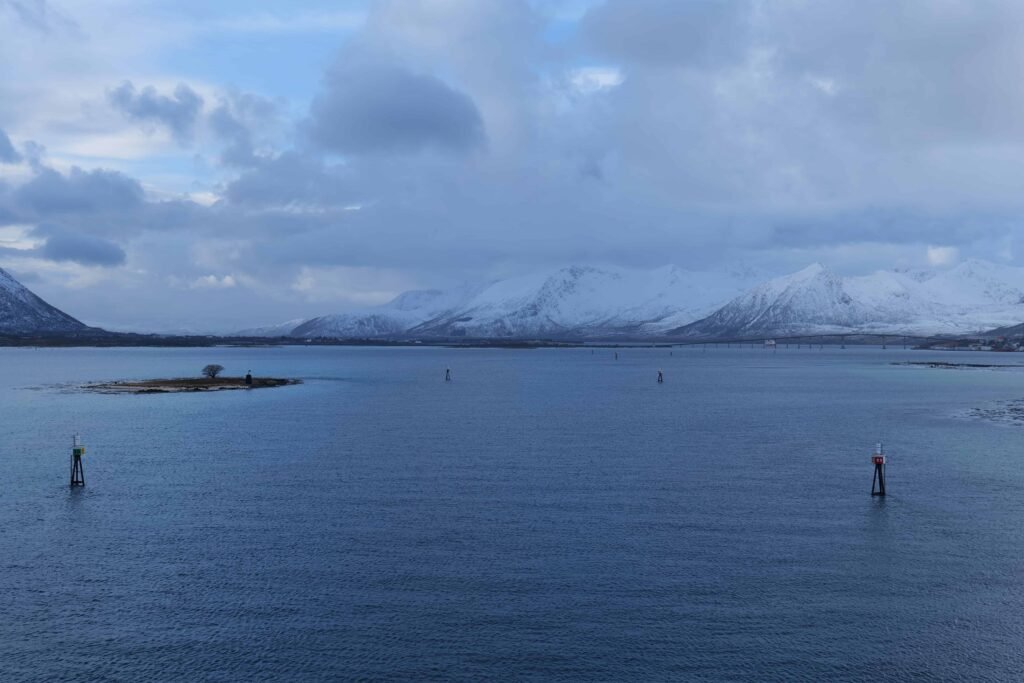
In my opinion, this is where day 9 earns its reputation as one of the most beautiful parts of the entire 12-day Norway Coastal Express itinerary!
The approach to Risøyhamn is stunning, so this is one you don’t want to miss.
Around 10:15am, head to the front of the ship to watch as you sail expertly through the narrow Risøy Channel – a tiny, shallow and incredibly scenic stretch of water.
Standing on deck gives you a sense of how skilled the captains are to be able to navigate this challenging stretch of Norway’s coastline.
Then, Risøyhamn itself is a tiny community that you would never get to visit any other way.
It’s home to just 200 people, and is incredibly scenic and unspoilt, with quiet, colourful houses framed by mountains. Your stop here is short, so you can’t get off and explore, but you should definitely be on deck for some incredible photo opportunities.
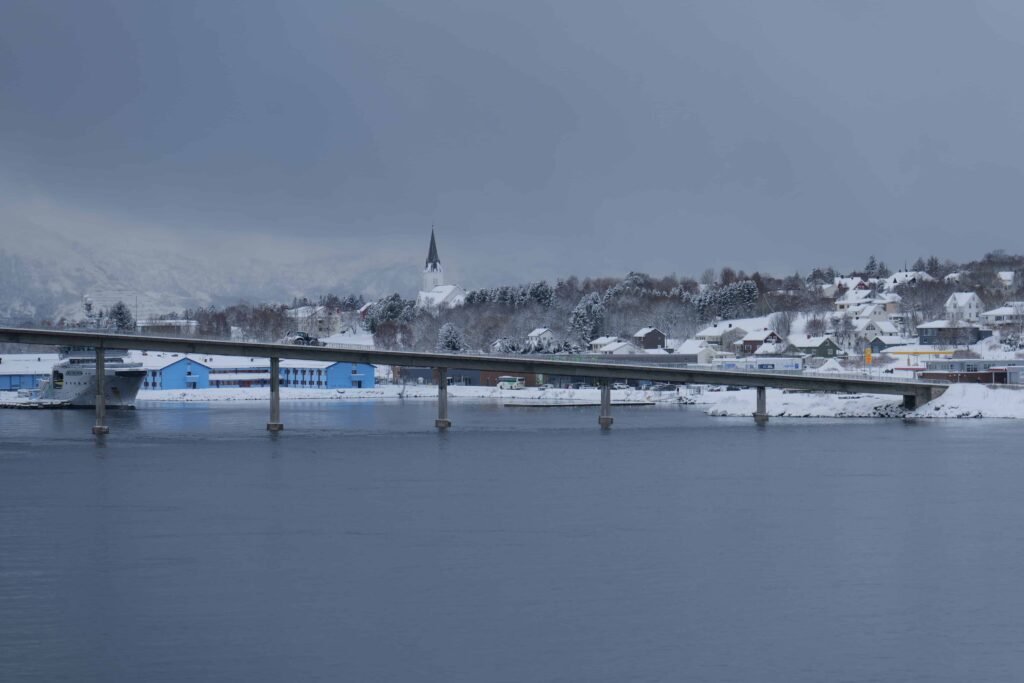
Sortland: 12:30pm–1pm
Sortland is one of the quirkiest Norway Coastal Express ports, because a lot of the town is famously painted in shades of blue!
It was part of an art project years ago, in 1998, to bring attention and visitors to the town – and now it’s become Sortland’s signature look.
This is another short stop where you won’t have time to walk far if you do get off.
I especially loved photographing the pretty white church on the hill, surrounded by mountains and the famous blue buildings. The best view of this is from the top deck.
Plus, you’ll also witness a surprisingly fun tradition on the Norway Coastal Express: waving flags out on deck at the excursion bus from Harstad, as it crosses the bridge above you.
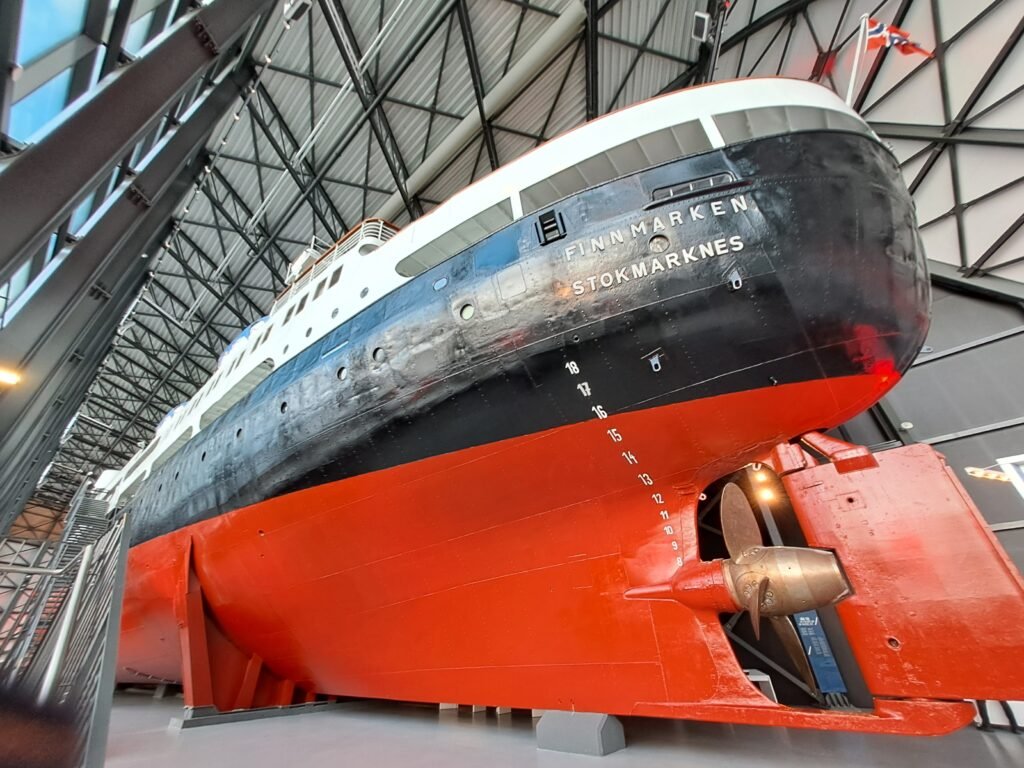
Stokmarknes: 2:15pm–3:15pm
Stokmarknes is where Hurtigruten was born, and honestly, it’s one of the most interesting stops on the entire Norway Coastal Express itinerary.
This tiny town is home to the Hurtigruten Museum, and even if you don’t think you’re a museum person (because same here!), it’s well worth a visit.
You could just walk around town on this port call, but I really recommend heading straight to the museum (you get a discount as a Havila or Hurtigruten passenger, too!)
As part of the museum, you get to go on board the old MS Finnmarken and see what life was like on the route decades ago.
From the original cabins and old dining room, to the lounges and even the bridge, you’ll learn more about the history of this vital route in such an immersive way!
Afternoon Sailing Through the Raftsund + Trollfjord
After leaving Stokmarknes, make sure you wrap up warm and stay outside, as this is one of the most dramatic stretches of the whole Norway Coastal Express itinerary!
If you’re travelling in winter (like me!), it’s finally light and early enough to enjoy the spectacular Raftsund Strait – a narrow corridor of mountains and scenery that looks like it should be on a Christmas card!
And this is also where you’ll see the famous entrance to Trollfjord.
In winter, the ship doesn’t enter the fjord itself, but the photo stop is still absolutely stunning. (I braved a full-on snow storm to stay outside and see it – and can confirm it’s worth it!)
There is also another Trolldrink ceremony on board during this sailing, where you will collect another souvenir cup if you choose to take part.
Katie’s Top Tip: For the best view of Trollfjord, head to the front of deck 9 or the bow viewpoint. The captain will stop the ship for a while here, so you can take some incredible photos of this narrow fjord.
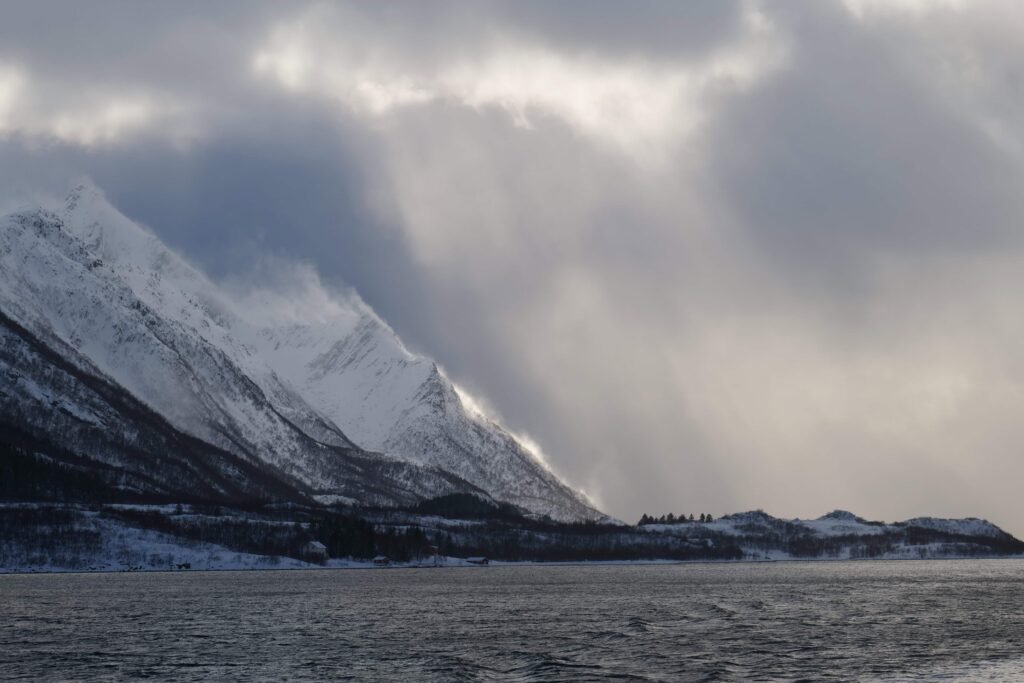
Svolvaer: 6:30pm–8:30pm
Svolvaer is known as the capital of the Lofoten Islands, and is surrounded by mountains and spectacular coastal scenery, so you’ll want to get off for a walk.
If you’re visiting in winter, like me, it will be pitch black when you arrive. But it’s still worth walking around the harbour to see the lights reflected in the water and the shadowy outline of the mountains.
The harbour area is compact, well-lit, easy to explore, and there are always plenty of other passengers around, so I felt very safe here as a solo female traveller.
If you want more ideas for what to do in this charming Arctic town, I have a full guide to the best things to do in Svolvaer!
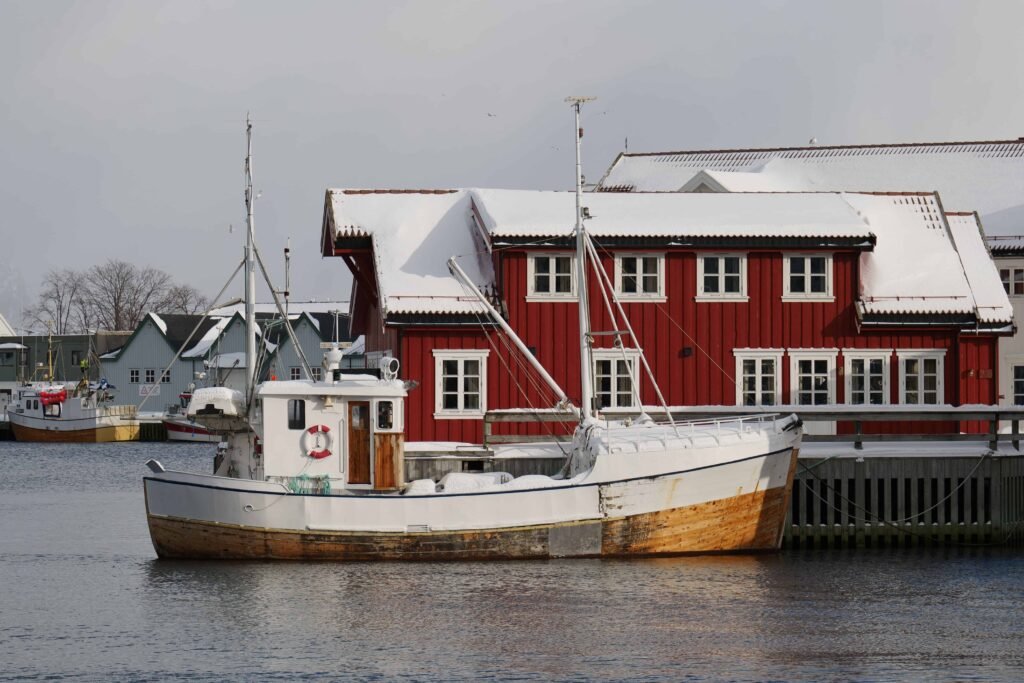
Stamsund: 10:15pm–10:30pm
Stamsund, a small fishing village with colourful buildings gathered around the harbour, is your final port call of the day (and in the Lofoten Islands).
It’s too short a stop to get off, but if it’s still light, make sure you head up on deck to admire the coastal scenery and traditional rorbuer cabins along the shoreline.
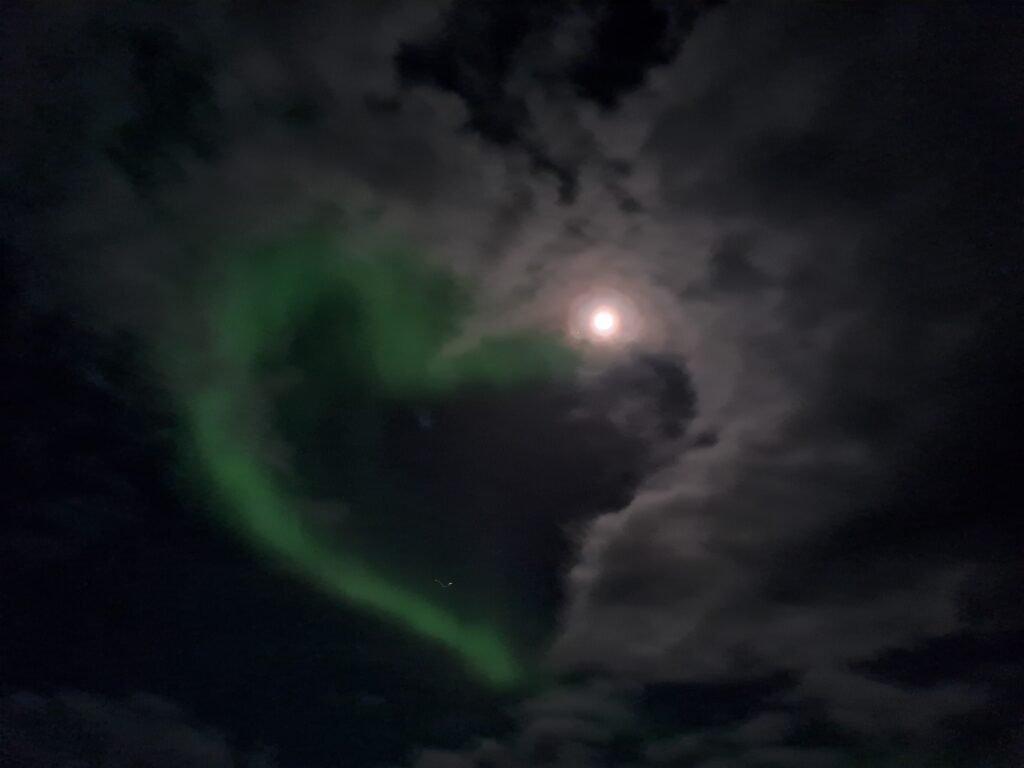
We also saw the Northern Lights here, for the third time on our voyage.
Day 10 – Norway’s Helgeland Coast
Bodø: 2:30am–3:30am
Bodø is one of the bigger Norway coastal ferry ports, and on the northbound route, you had the chance to explore (and maybe even see the impressive Saltstraumen Tidal Current!)
On the southbound voyage, you still have a relatively long stop here, but this is for logistics only, as your ship docks in the middle of the night.
Ørnes: 6:25am–6:35am
Ørnes is a tiny coastal town that you will have passed during the day on the northbound voyage. It is also your last port of call before you re-cross the Arctic Circle.
The ship only stops here for ten minutes in the early morning, but if you’re already awake, head outside or to the panorama lounge to admire some more stunning coastal scenery!
Re-Crossing the Arctic Circle (around 8:30am)
Your southbound crossing of the Arctic Circle feels very different from the northbound one.
For me, I was excited to see the famous Vikingen Globe again, but I was also sad that our time in the Arctic had come to an end. I just loved the scenery in the far north!
I also found it was a lot quieter on deck during this re-crossing, and there is no ceremony this time, so the moment was a lot more peaceful.
And on my voyage in winter, the light at this time of the morning was magical – every photographer’s dream!
Katie’s Top Tip: I highly recommend you stay out on deck or in the panorama lounge for the entire day today! This was by far my favourite day of the voyage for spectacular coastal scenery.
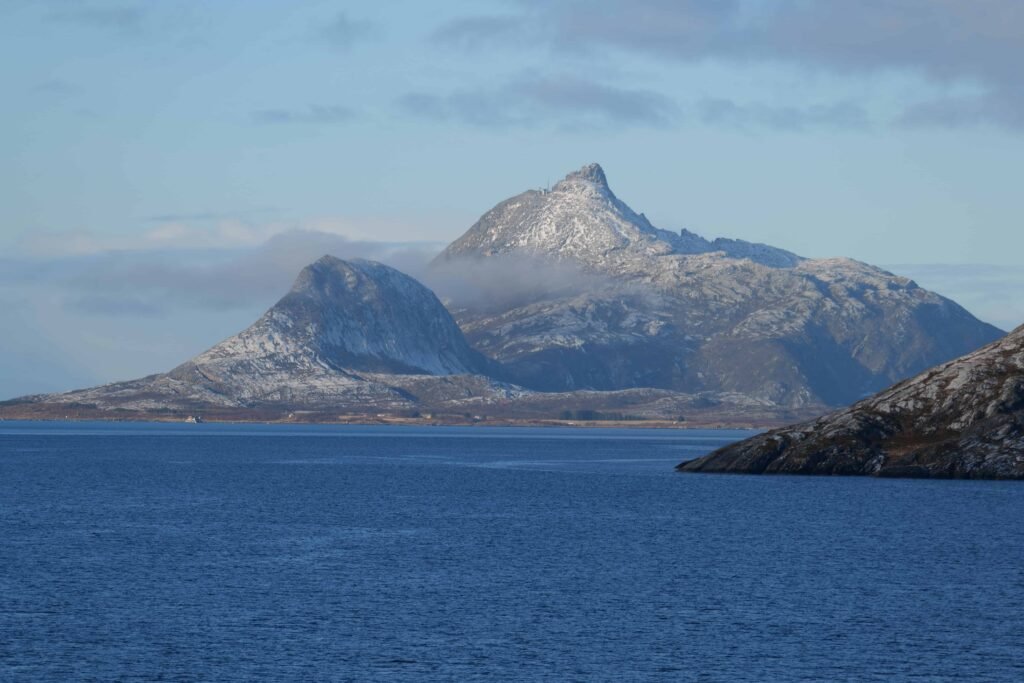
Nesna: 10:25am–10:35am
Beautiful Nesna is a Norwegian ferry port that you pass early in the morning on the northbound journey, so southbound is your first real look at it.
It’s a small coastal town with a lot of importance for locals in Nordland county. Nesna has a vital ferry link for many smaller communities you will have seen on the sail in, as well as being home to a campus of Nord University.
With only a 10-minute stop, you won’t have time to get off and explore, but stay out on deck as you sail in and out, to admire the surrounding scenery.

Sandnessjøen: 11:45am–12:15pm
Sandnessjøen is a bigger town in Nordland county, but still has that picturesque charm you’ll have come to know and love on this voyage! The surrounding rugged mountains are spectacular, and when we docked, the port was bustling with life.
It was almost surreal to see such a vibrant town after days of remote, Arctic communities!
But the real highlight isn’t the port itself, but what comes after.
Once you leave Sandnessjøen, get yourself straight out on deck on the port side, because within 10–15 minutes, you’ll start passing the Seven Sisters mountain range.
This stretch is one of the best for scenery – the sharp, dramatic peaks of the Seven Sisters, rising one after another, are truly spectacular to see.
When I sailed in winter, our crew told us no Havila ship had seen the Seven Sisters for months, due to bad weather and cloud cover. So seeing them under such glorious sunshine was magical!
Brønnøysund: 3pm–5:25pm
Brønnøysund completely surprised me, but in the best way!
This small coastal town sits exactly halfway between North Cape and Lindesnes (the northernmost and southernmost points of Norway), making it the middle of Norway’s coast.
You’ll also spot a small monument to this fact in the harbour, which is a great photo opportunity.
You’ll have a couple of hours to explore here, which is perfect for a gentle walk.
I recommend you start along the waterfront and harbour area, before heading back a few streets to the beautiful church, and then finish by the picturesque lake behind town.
Brønnøysund isn’t a headline port in the way bigger stops on this route are, but that’s exactly why I loved it! It felt very real, authentic and local.

Mount Torghatten
Today was all amazing, but the true highlight for me came just after we left Brønnøysund.
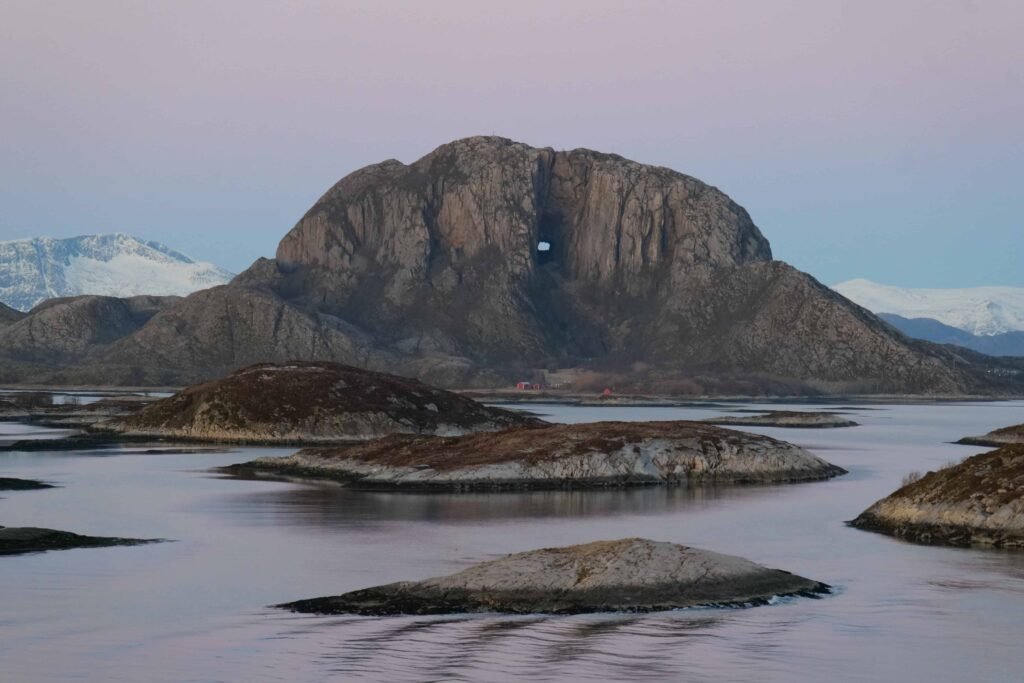
As you sail out of Brønnøysund, make sure you stay out on deck, as the ship usually makes a small detour to give you a perfect view of Torghatten – the iconic mountain with the hole!
When I sailed in winter, on March 9th, it was very close whether we’d still have enough light left to see it, but we were treated to the most stunning pink sunset overhead.
Seeing Torghatten glowing in that soft, evening light was honestly one of my favourite moments of the entire 12-day voyage!
Rørvik: 9pm–9:30pm
Rørvik is a regular working port, known for its incredibly busy Rørvik Strait. We passed the northbound Hurtigruten service here, as well as lots of other big ships out in the strait, so it’s worth getting out on deck if you’re interested in shipping.
But, by this time of night (in winter), it’s completely dark, so you won’t see much except the lit-up harbour and, of course, other nearby ships.
Day 11 – Trondheim and Kristiansund
Trondheim: 6:30am–9:30am
If you missed Trondheim on the northbound part of your Norway Coastal Express itinerary, this is your second chance, and it’s well worth the early alarm!
I was on deck by 6am on my sailing (as I couldn’t sightsee northbound due to bad weather), and watched the sunrise across the water before heading out to explore.
I found Trondheim to be a very peaceful, welcoming city as a solo female traveller, and visiting early in the morning only made it feel more local and authentic.
Three hours gives you enough time to see Trondheim’s highlights, but keep in mind that it is a 30-minute walk each way to get back to the ship, so you’ll want to leave promptly.
I walked along the river, crossed Gamle Bybro into the charming Bakklandet neighbourhood, and then looped back via the cathedral and Nidelva waterfront, before heading for breakfast.
By the time I got back on board, I was exhausted and hungry, but it was absolutely worth it!
Also, keep your camera out as your ship departs, as you’ll get another view of Munkholmen Island from the top deck.
Kristiansund: 4:30pm–5:30pm
Most of day 11 is spent at sea, so you’ll want to get off to stretch your legs in this charming waterfront town. This is also the final port where you can get off before Bergen.
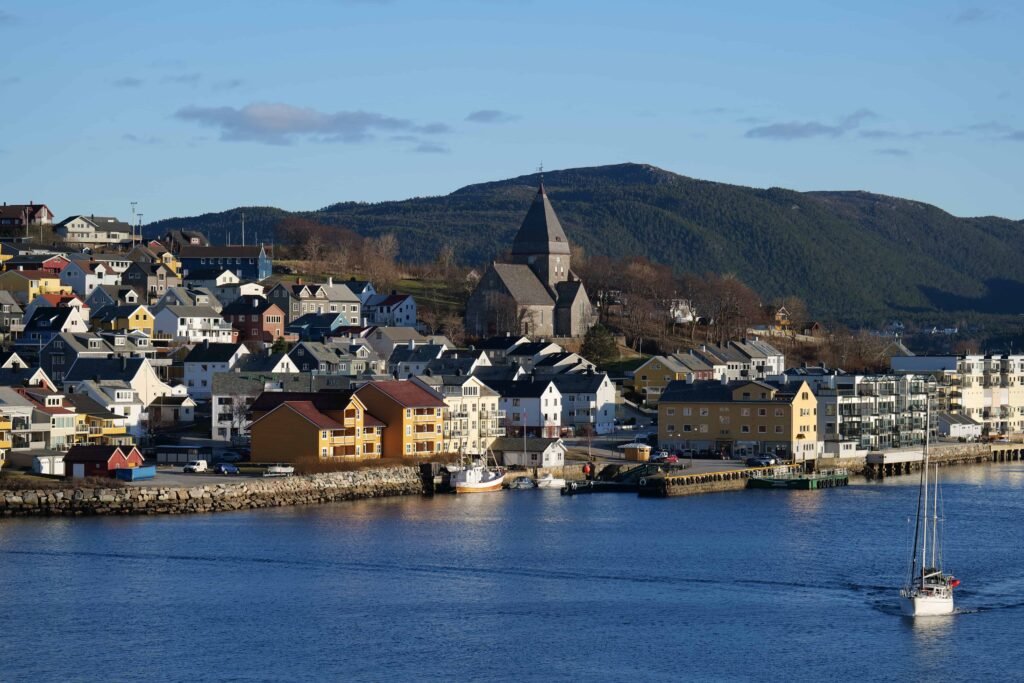
Kristiansund is spread across four small islands, so everywhere you look, you’ll see colourful houses set against the water! And I especially loved the view of the church from the deck.
Also, keep an eye out for the iconic Sundbåten ferry, which is one of the world’s oldest public transport systems, that’s been continuously running since 1876.
Molde: 9:15pm–9:45pm
You’ll again see the bustling town of Molde in the late evening, although it is earlier than on the northbound leg of the journey.
Given the late arrival, you will likely only want to admire Molde from your cabin window or out on deck. But if you do want to stretch your legs before bed, there is enough time here for a walk around the port.

Day 12 – Arrival in Bergen
Ålesund: 12:30am–1:20am
Ålesund is one of Norway’s most famous Art Nouveau towns, but on the southbound route, you’ll arrive after midnight and only stay in port for 45 minutes.
So you will have needed to do all of your sightseeing on the northbound part of the voyage, where the ship stays docked in Ålesund all day, or you can visit nearby Geirangerfjord.
Torvik: 2:35am–2:45am
Torvik is a tiny coastal community and one of the quickest port stops on the entire route, docking for just 10 minutes before you continue south towards Bergen.
You might have had the opportunity to see it in daylight on the northbound voyage.
Måløy: 5:45am–6am
Måløy is a classic fishing town and another small but scenic port on the Norway Coastal Express itinerary.
If you’re an early riser, you might get to see Måløy on this leg (as it arrives in port later than on the northbound voyage), but most passengers won’t see a port stop until Florø.
Florø: 8:15am–8:30am
Florø is the final port you’ll experience on your Norway Coastal Express itinerary before you arrive back in Bergen, and it’s absolutely worth heading outside for.
As Norway’s westernmost town, Florø has beautiful coastal scenery, dotted with little islands. And even though the stop is only 15 minutes, the views from the deck are lovely.
Also, stay on the port side after leaving Florø for the best view of Stabben Lighthouse.
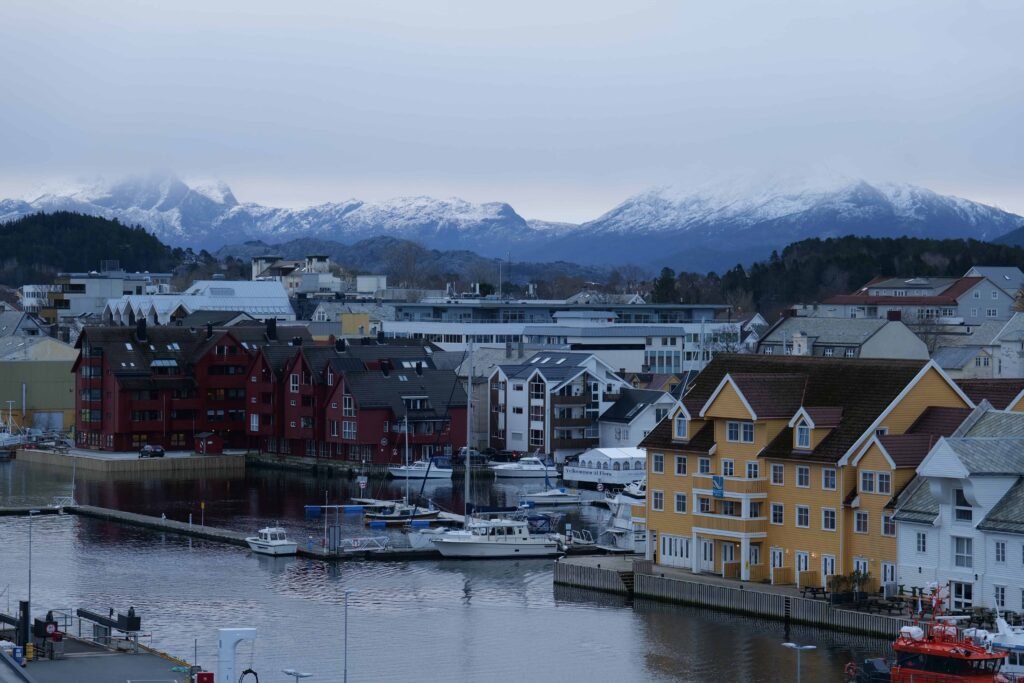
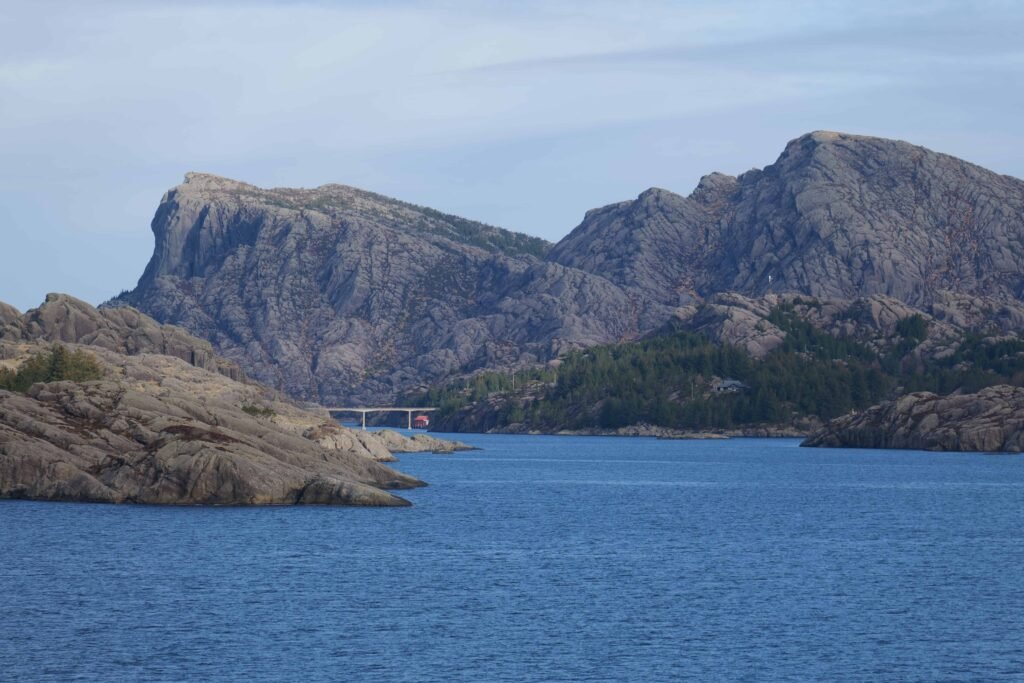
Sailing through the Stone Strait: 10:45am
By this point, you’ll have checked out of your cabin and left your luggage for collection, so grab a seat in the panorama lounge to enjoy the rest of the voyage.
Around 10:45am, you’ll sail through the Stone Strait, which I found was one of the most unexpectedly beautiful stretches of the whole journey – and the perfect ending to the cruise!
The strait is incredibly narrow, with rugged cliffs on both sides, and it’s fascinating to watch the ship expertly sailing through this section of water.
Arrival in Bergen (~2:45pm)
Your approach to Bergen is your final opportunity to take photos of your voyage, so head outside one last time to watch as you dock.
On the approach, you’ll pass more little coastal communities and islands, before the recognisable city skyline of Bergen comes into view.
Also during this time, you’ll enjoy a farewell lunch, before disembarking deck by deck, collecting your luggage from the terminal, and leaving the ship for the final time.
If you are heading straight to the airport, I recommend booking the bus that will take you straight there. Or you can walk 15 minutes to Byparken and get the light rail.
But if you haven’t already, I would definitely recommend staying a night or two longer to explore the highlights of beautiful Bergen!

Final Thoughts
Planning your Norway Coastal Express itinerary is so much easier once you understand how the port stops actually work, from the long calls you can explore properly, to the tiny communities you’d never get to see otherwise.
Now that you have a clear breakdown of every port, northbound and southbound, you can plan your days confidently, pick your dream excursions, and still leave room for those spontaneous moments that make this voyage so special.
Happy sailing – I hope you have the best time!
Read More About Travel in Norway:
- Northbound vs Southbound Norway Coastal Express: Compared
- What to Wear in Norway in Winter? (+ Norway Packing List)
- How to Plan a Trip to Norway in Winter (Step-by-Step Guide)
- Norway vs Iceland in Winter: Ultimate Solo Travel Comparison
- Where to Stay in Bergen (+ Best Areas For Solo Travellers)
- Where to Stay in Tromsø (+ Best Areas For Solo Travellers)
- Hurtigruten vs Havila: Which is Best For Solo Travellers?
- Is Saltstraumen Worth Visiting from Bodø? (+ What to Expect)
- How to Get Around Norway in Winter (Without a Car!)
- How to Visit Trollfjord: Northern Norway’s Most Iconic Fjord
- How to Visit Mostraumen Fjord (Bergen’s Best Day Trip!)
- 7 Things To Do in Hammerfest (Hammerfest Travel Guide)
- Mount Aksla Hike: How to Find the Best Ålesund Viewpoint
- 8 BEST Things To Do in Brønnøysund, Norway: Havila Port Stop
- 21 Most Beautiful Places in Norway You Have To Visit
Grab Your Solo Female Travel in Europe Starter Kit:
Pin Me For Later!


Really helpful breakdown of the Coastal Express itinerary. This makes planning a Norway trip so much easier!
Wonderful. This is the kind of information I’ve been looking for over the past few weeks. I’ve book-marked this page for future reference. Thank you.
So much great information. We tried to go on a Norwegian Cruise in 2021. Sadly, my youngest got covid right before were supposed to sail and we had to quickly create new plans. Norway is still on my list, but I did get to visit the Cotswolds instead and that was a treat.
So many beautiful places to stop! Love the photos of the mountain with the heart in it, and the dramatic Northern Lights.